
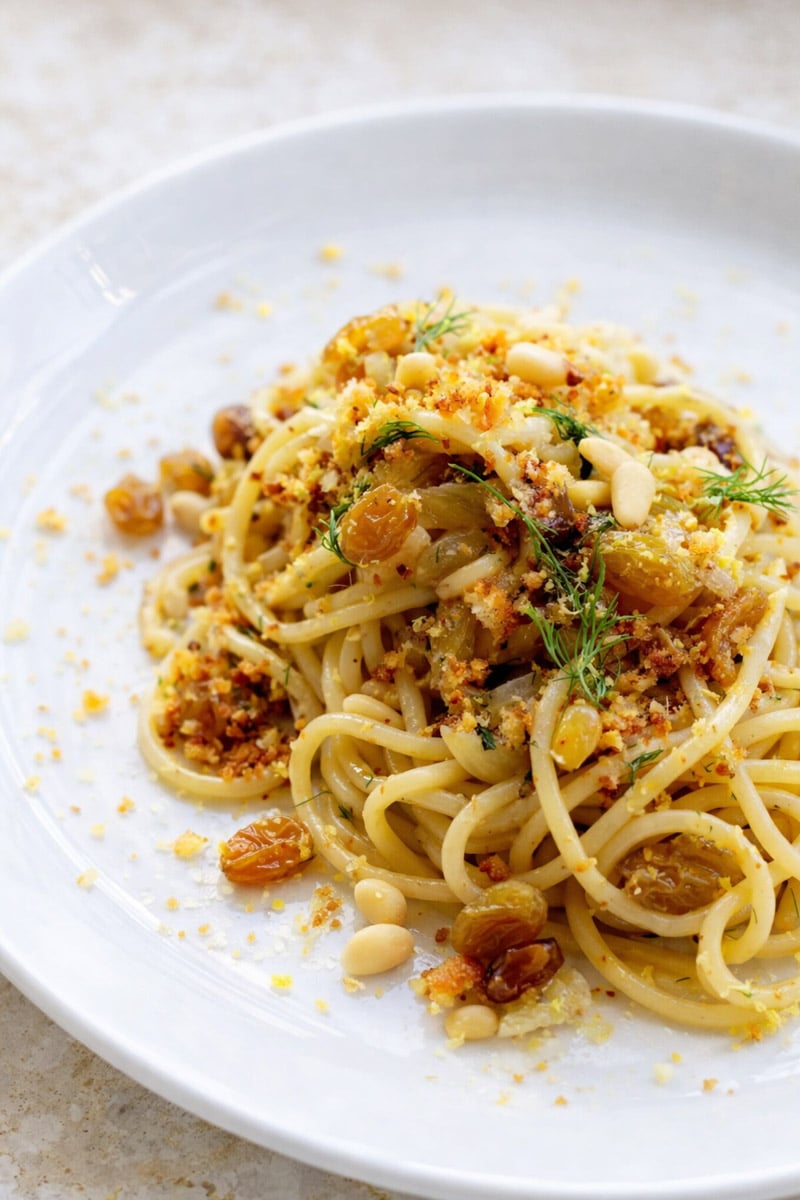
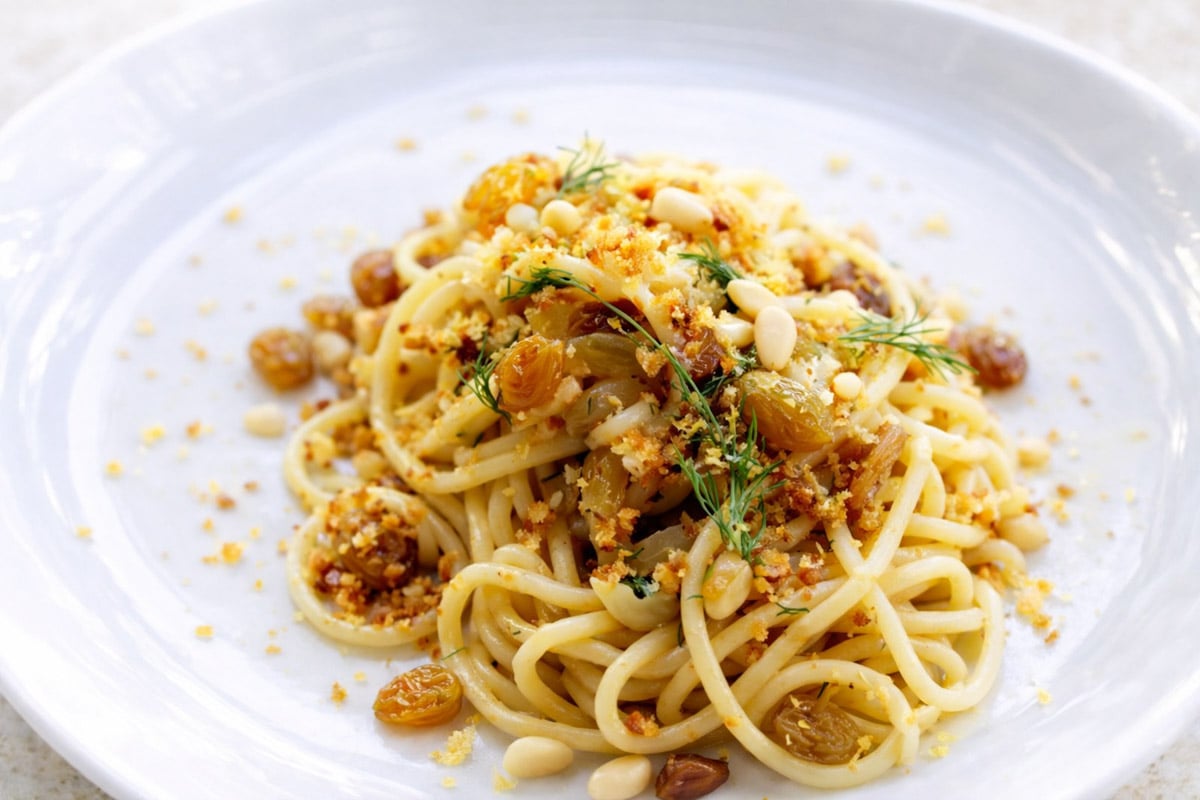
Pasta con le sarde is one of the most iconic dishes from Sicily. It brings together fresh fennel, saffron, sardines, raisins, pine nuts, and anchovies to create a flavorful pasta you only find in southern Italy. The mix of sweet and savory makes this Italian sardine pasta stand out, and it is one of those recipes you crave again after the first bite.
Other Sicilian recipes I love are the Sicilian Fennel and Orange Salad and the Sicilian Savoiardi Cookies
This article contains affiliate links which support us at no extra cost to you.
Jump To
- Why you'll love this pasta with sardines
- Ingredients
- Equipment you need to make this pasta
- How do you make homemade breadcrumbs?
- How to make pasta with sardines? (Step-by-step)
- Recipe Variations/Substitutions
- Where did the feast of the seven fishes originate?
- Why the number seven for the feast of seven fishes?
- What seafood do you eat on the feast of the seven fishes?
- Pasta con le Sarde expert tips:
- What to Serve with Pasta con le Sarde
- Using Cultivated Fennel Instead of Wild Fennel
- Do you make pasta con le sarde with tomatoes or without?
- FAQ'S
- Some other Sicilian recipes to enjoy:
- Pasta con le Sarde (Pasta with Sardines)
If there is one recipe that sums up all of Sicily for me, it has to be pasta with wild fennel and sardines. Pasta con le sarde (pasta with sardines) is a dish so subtle, mysterious, and harmonious.
Pasta con le sarde is called pasta chi sardi in Sicilian dialect, and this recipe magically brings together very distinct Arabic ingredients, creating a quintessential Sicilian pasta recipe.
What most Americans don't know is that many Italian recipes (mostly, Italian-American dishes)that Italians grew up eating in the States, have origins in Sicily (and in the other regions where the immigrants came from, like Campania and Calabria).
Why you'll love this pasta with sardines
- Pasta con le sarde is an easy-to-make, yet delicious dish that can be enjoyed any time of the year.
- The combination of saffron, fennel, anchovies and raisins provides a unique flavor profile that you won't find in other pasta dishes.
- It's also very versatile since it can be served with a variety of sides, such as vegetables, cheese, or even seafood.
- This makes it an ideal meal for dinner parties and other large gatherings.
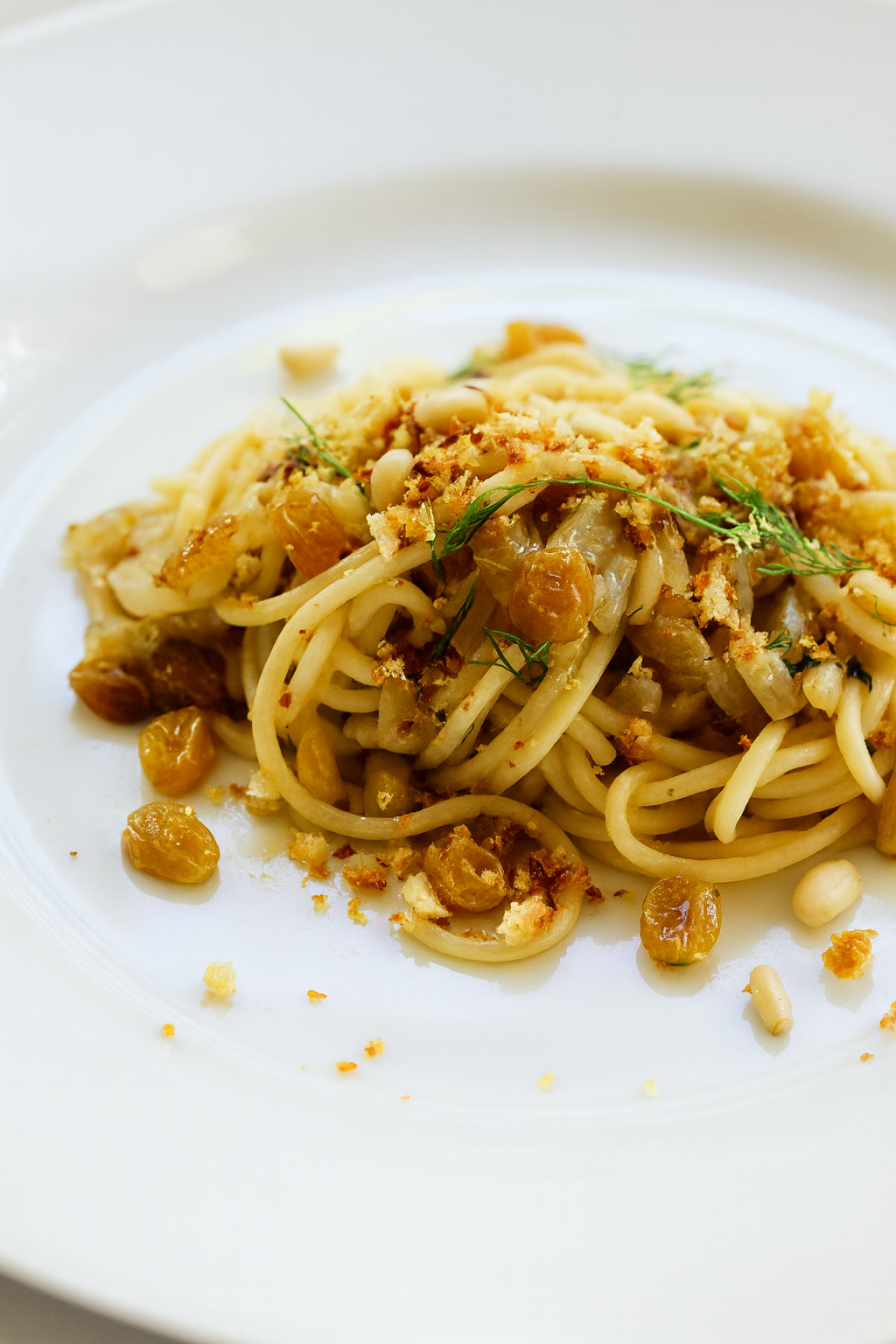
Ingredients
- Baby fennel bulbs with their fronds: They lend a beautiful, mild, liquorice-like flavor to the dish and also add a lovely crunch.
- Fresh sardines: They are the star of the dish, providing a rich, oily, and distinctive flavour. If fresh ones are not available, canned ones can also be used.
- Extra virgin olive oil: Used to sauté the ingredients, it adds a fruity depth and helps meld the flavors together.
- Onion: Adds a necessary sweetness and depth to the flavor profile.
- Salt-cured anchovies: They bring a unique, umami, and salty kick to the pasta sauce.
- White wine: Deglazing the pan with white wine adds a refreshing acidity to balance the richness of the other ingredients.
- Bucatini, spaghetti, or linguini: Long pasta shapes are traditional for this dish, capturing the sauce well.
- Toasted pine nuts: They add a lovely crunch and a buttery flavor, enhancing the overall eating experience.
- Raisins or currants: These add a hint of sweetness contrasting beautifully with the savoury elements.
- Sea salt and freshly ground black pepper: Basic seasonings to elevate all the other flavors in the dish.
- Toasted breadcrumbs for garnish: For added texture and to give the dish a beautiful finished look.
- Lemon zest: A final grating of lemon zest adds a punch of freshness lifting all the flavors.
Equipment you need to make this pasta
- A cutting board and a sharp knife for prepping vegetables
- A large pot for boiling pasta
- A large skillet for sautéing the ingredients
- A colander for draining the pasta
- Tongs or Pasta Spoon: To serve the pasta.
How do you make homemade breadcrumbs?
Here is what you need to make your own breadcrumbs:
- 3-4 slices of bread (whatever you prefer)
- 2 tablespoons extra virgin olive oil
Preheat the oven to 300°F. Grind the bread up in a food processor. 3-4 slices of bread should yield about 2 cups of bread crumbs. In a large bowl, toss the breadcrumbs with olive oil. Place the breadcrumbs on a baking sheet and toast for about 10 minutes until golden brown (rotate halfway through). Allow the breadcrumbs to cool.
Place the breadcrumbs in the food processor and pulse a few times until the breadcrumbs are finely processed. Store in an airtight container. I keep this batch of breadcrumbs in a plastic container in the fridge and use it up in about a month.
How to make pasta with sardines? (Step-by-step)
- Boil the fennel: Bring a large pot of salted water to a boil. Drop in the baby fennel and fronds and cook until tender, about 8 to 10 minutes. Drain and chop; set aside. If you can't find baby fennel, use chopped fennel and cook with the onion.
- Cook the sauce: Heat a large skillet with ¼ cup olive oil. Add the onions and saute until soft but not browned, about 5 minutes. Add the white wine and the anchovies and break up with a wooden spoon.
- Boil the pasta: Meanwhile, drop the pasta into a pot of salted water and cook until just al dente. Drain and set aside.
- Add ingredients to the sauce: Add the reserved fennel, raisins, pine nuts, and a ladle of pasta cooking water to the skillet.
- Simmer: Cover and simmer for 10 minutes.
- Add the sardines: and continue to cook, uncovered, until the sardines are cooked through.
- Add the reserved pasta and a good drizzle of extra virgin olive oil. Stir to combine. Season with salt and pepper.
- Garnish with the breadcrumbs and lemon zest.
Recipe Variations/Substitutions
If you're having trouble finding some of the ingredients or you're looking to mix things up, here are some variations and substitutions you can try in your Pasta con le Sarde:
- Canned sardines: If fresh sardines aren't available, canned sardines in olive oil are a great substitute. They're already cleaned, deboned, and ready to use.
- Anchovy Substitute: If anchovies aren't your thing, you can substitute them with capers. The capers will still provide that salty punch without the fishy taste.
- Pasta Type: Although this recipe calls for bucatini, you can use other types of pasta such as spaghetti, linguini, or even penne.
- Nut-Free: If you're allergic to pine nuts, you can substitute them with roasted chickpeas for a similar crunch.
- Vegetarian Version: Substitute the sardines with sautéed mushrooms or aubergine (eggplant) for a vegetarian version of this dish. You can also add a sprinkle of nutritional yeast to mimic the savory flavor of the sardines.
Where did the feast of the seven fishes originate?
The Feast of the Seven Fishes on Christmas Eve originates most likely in Sicily or even Naples. My family in Sicily and my in-laws that are Calabrian (but live most of the year in the Lombardy region) don't make 7 actual courses of seafood.
My one aunt in Sicily will have an antipasto (maybe calamari fritti)and a pasta dish with seafood. My Calabrian mother-in-law on Christmas Eve will usually make an appetizer with salmon, and a seafood pasta.
So it seems the tradition of seven fish dishes carried over with the immigrants and became more of an Italian-American feast. Why exactly the number of 7 fish dishes? The Catholics fast on Christmas Eve and don't eat meat. They break the fast on this special cena della vigilia (Christmas Eve dinner) with fish.
Why the number seven for the feast of seven fishes?
There are many theories:
- It took seven days for God to create the earth, the Bible says.
- The number seven also could be representative of the sacraments.
- There are also those families where the number three holds more significance than seven, perhaps as it represents the Three Wise Men and the Holy Trinity.
Some Italian families do go all out and make 13 different fish dishes. Twelve of those dishes are representative of the apostles and the last one is for Jesus.
This is a pasta my father used to make and it reminds me of him. It will be my final addition to my #ProjectSicilia. I will attempt next year to be more active in sharing a Sicilian recipe every month. I'm sharing it for my personal record and for my kids to one day look back on and feel connected somehow through a recipe with their Nonno Rosario and their ancestors from the most splendid island in the world: Sicilia.
What seafood do you eat on the feast of the seven fishes?
In my family this is what we enjoy:
- baccalà
- squid
- scungilli
- calamari (usually fried)
- clams
- mussels
- a white fish
There are so many dishes and variations, but my mom and dad used to make an appetizer of stuffed clams, also some fried calamari and a mountain of pasta with mixed seafood. One of my best food memories of my parents collaborating in the kitchen was for this festive and delectable evening.
Pin it to your ITALIAN FOOD, DINNER, or PASTA Board to SAVE for later!
Find me on Pinterest for more great recipes! I am always pinning :)!
What to Serve with Pasta con le Sarde
A simple, crisp Italian salad, such as an Insalata Mista - a mix of fresh greens, tomatoes, olives, and a light vinaigrette - can provide a refreshing contrast to the pasta's intensity. You could also consider a classic tomato salad.
A crusty Italian bread like Ciabatta or Focaccia is perfect to mop up the sauce. Pair with a Sicilian white wine, such as Grillo or Catarratto, which will complement the sardines and cut through the richness of the dish.
For dessert, consider a light and tangy lemon sorbet or a slice of Cannoli Siciliani, a classic Sicilian dessert that wraps up the meal beautifully.
Using Cultivated Fennel Instead of Wild Fennel
In the traditional pasta con le sarde recipe, wild fennel is used. It grows in the wild, has tufty fronds rich in aroma, and requires longer cooking time due to its toughness. This wild fennel is usually blanched, chopped, and added to the sauce, infusing the pasta with intense fennel flavor.
However, if wild fennel is not available, cultivated fennel works just as well with a few adjustments. Begin by utilizing both the bulb and the fronds. Dice the bulb and sauté it with onion, creating a deep fennel base.
The fronds can be used as fresh herbs, enhancing the overall taste. To get the wild fennel intensity, instead of expensive fennel pollen, use ground toasted fennel seeds mixed with the breadcrumb garnish.
Do you make pasta con le sarde with tomatoes or without?
It depends! I learned that cookbook author Pino Correnti argues that the tomato-less recipe published in 1886 by the folklorist Giuseppe Pitrè is the only authentic version. In my Sicilian family, it has always been made without tomatoes.
Now if we were lucky enough to be in Sicily, it would be no problem to find wild fennel as it grows all over the island. If you can't get a hold of wild fennel, use the tops of the fennel bulb and the fennel.
FAQ'S
Sardines are a very popular dish in Sicily, and many Sicilians enjoy eating them. In fact, there are several traditional dishes that feature sardines as the star ingredient, such as pasta con le sarde or pane ca meusa (salt-cured beef with sardines).
Pasta alla Norma is a popular Sicilian pasta dish that features long, thin noodles tossed with eggplant, tomato sauce, and ricotta salata cheese. Another popular Sicilian pasta dish is pasta con le sarde, which combines saffron, fennel, anchovies and raisins.
The best accompaniments for sardines are usually other strong flavors that balance out the fish's umami taste. Typical sides include grilled vegetables, capers, olives, potatoes, tomatoes, and a variety of other herbs and spices. A drizzle of extra virgin olive oil will bring out the flavor even more.
A can of sardines can be used to make a variety of dishes. One popular recipe is pasta con le sarde, which combines the flavors of saffron, fennel, anchovies and raisins. You can also use it in recipes like salads or sandwiches.
Pasta con le Sarde traces its roots back to the sun-drenched, culturally-rich island of Sicily, situated off the southern coast of Italy. This traditional pasta dish is an embodiment of the island's vibrant food culture, elegantly marrying local ingredients with distinct flavors. It is believed to have been invented during the Arab conquest of Sicily, with the recipe having been inspired by the local availability of sardines and wild fennel.
Sardines are a staple in Italian cuisine, especially in coastal regions like Sicily where they are abundant. Italians prepare sardines in a variety of ways - they are often grilled, baked or fried and served as a main dish or appetizer, seasoned with herbs and drizzled with olive oil.
Some other Sicilian recipes to enjoy:
- Sicilian Sesame Seed Cookies
- Sicilian Pasta with Cauliflower
- Sicilian Scacciata with Cauliflower
- Eggplant Timballo-Timballo di Melanzane
- Chocolate and Chestnut Cake {torta al cioccolato e le castagne}
- Easy Gluten-Free Stuffing (with Rice)
- Vegan Creamy Tomato Pasta
Did you make this and love it? Please RATE THE RECIPE below:)
I would LOVE IT if you can leave me a star rating and a review down below and let me know your thoughts! It means the world to me to hear how you liked it.
Please Subscribe and give a follow on Instagram, Facebook, Pinterest, and TikTok xx

Pasta con le Sarde (Pasta with Sardines)
Equipment
- 1 Pot
Ingredients
- 1 bunch about 6 baby fennel bulbs with their fronds
- 1 to 1 ¼ pounds fresh sardines cleaned, scaled, deboned, and roughly chopped (or 2 tins of canned sardines)
- extra virgin olive oil
- 1 medium onion finely diced
- 3 salt-cured anchovies
- ½ cup white wine
- 1 pound pasta bucatini, spaghetti, or linguini
- ¼ cup toasted pine nuts
- ¼ cup raisins or currants
- sea salt and freshly ground black pepper
- toasted breadcrumbs for garnish
- lemon zest
Instructions
- Bring a large pot of salted water to a boil. Drop in the baby fennel and fronds and cook until tender, about 8 to 10 minutes. Drain and chop; set aside. If you can't find baby fennel, use chopped fennel and cook with the onion.
- Heat a large skillet with ¼ cup olive oil. Add the onions and saute until soft but not browned, about 5 minutes. Add the white wine and the anchovies and break up with a wooden spoon.
- Meanwhile, drop the pasta into a pot of salted water and cook until just al dente. Drain and set aside.
- Add the reserved fennel, raisins, pine nuts, and a ladle of pasta cooking water to the skillet.
- Cover and simmer for 10 minutes.
- Add the sardines and continue to cook, uncovered, until the sardines are cooked through. Add the reserved pasta and a good drizzle of extra virgin olive oil. Stir to combine. Season with salt and pepper.
- Garnish with the breadcrumbs and lemon zest.
Nutrition Disclaimer
Please keep in mind that the nutritional information presented below is an approximation and may vary depending on the exact ingredients used.
Notes
- Pasta con le sarde is typically made with olive oil, onions, pasta and a mixture of sardines and anchovy. I used spaghetti in this recipe, but you could also use bucatini. Fresh pasta would be ideal, as the sauce just sticks better to the pasta.
- You flavor the dish up with wild fennel, pine nuts and raisins. It is very nice to add a touch of saffron (optional if you don't have it available). I like to add a splash of white wine and lemon zest to the sauce.
- And I top it off with the nice crunch of my own bread crumbs (it is so easy to grind and toast your own bread crumbs and adds a much better texture than canned bread crumbs, but use store bought bread crumbs if you don't have your own.
Excellent recipe...the sauce is so easy to make and the flavors were amazing! Thank you!!!
I thoroughly enjoy all your recipes and comments. My Italian heritage is Tuscany and Abbruzze. My husband is Sicilian and I learned many Sicilian dishes from my mother in law who was a fantastic cook. This recipe was one of my favorites. My own Mother, also a wonderful cook, whose style was more nothern. However, having been to Italy many times, we have learned to enjoy cooking from all over the country. All is cooking from the heart made by proud people. Keep up the good work! Happy Holidays to you and yours.
Ciao Loretta...you are so kind and lovely. I really appreciate your sweet comment and knowing you learned Sicilian dishes from your mother-in-law. All of the regions have such incredible and different dishes. And yes, it truly is cooking from the heart of proud people. Happy Holidays to you and your family...auguri...Buon Natale! XX Lora