
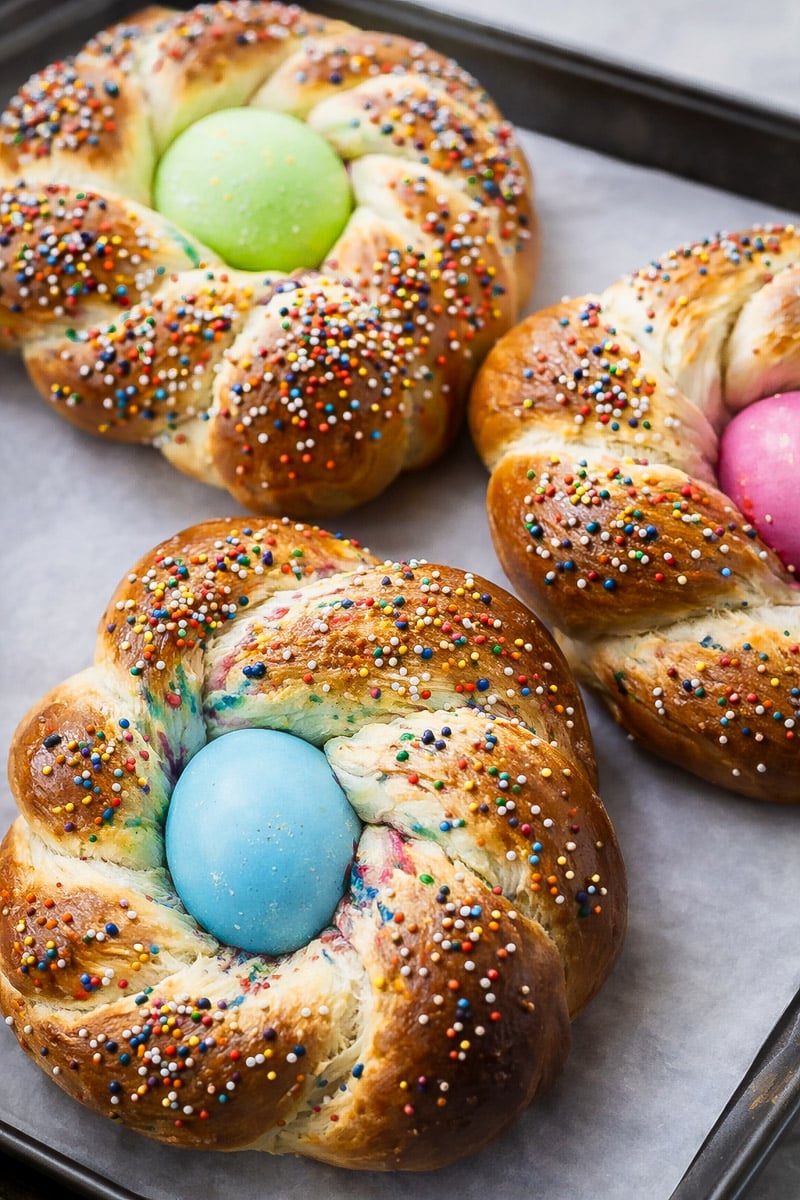
Braided Italian Easter Bread (Pane di Pasqua) is one of those Italian Easter bread recipes that I look forward to making every single year. It's soft, slightly sweet, and filled with so much tradition, colorful eggs nestled right into the braided dough, fresh out of the oven just in time for Easter Sunday. Whether you're making this for the first time or it's already a family staple, this is the recipe that belongs on your Easter table.
If you're putting together a full Italian Easter spread, be sure to also try my Casatiello and Torta Pasqualina Italian Easter Pie alongside this bread.
This article contains affiliate links which support us at no extra cost to you.
Jump To
- What Is Pane di Pasqua (Italian Easter Bread)
- Ingredients for Italian Easter Bread
- How to Make Italian Easter Bread (Pane di Pasqua)
- Should I Use Raw or Hard-Boiled Eggs?
- Tips for Making Italian Easter Bread
- Tips to store and make this Easter bread ahead of time:
- FAQ'S
- The Italian Easter Bread My Mother-in-Law Makes Every Year
- More Easter Recipes:
- Italian Easter Bread (Pane di Pasqua)
Why You'll Love This Italian Easter Bread Recipe
- It's a true family tradition. This is the recipe my Italian mother-in-law makes every Easter - passed down exactly as she makes it in Italy.
- Easier than it looks. The braided shape is impressive but the dough comes together simply with basic pantry ingredients.
- Perfectly soft and slightly sweet. The texture is tender with just the right hint of sweetness and lemon - not too rich, not too plain.
- The eggs bake right in. No extra steps - the raw colored eggs cook perfectly inside the bread as it bakes.
- Great for making ahead. The dough can be prepped the night before, which makes Easter morning so much easier.
What Is Pane di Pasqua (Italian Easter Bread)
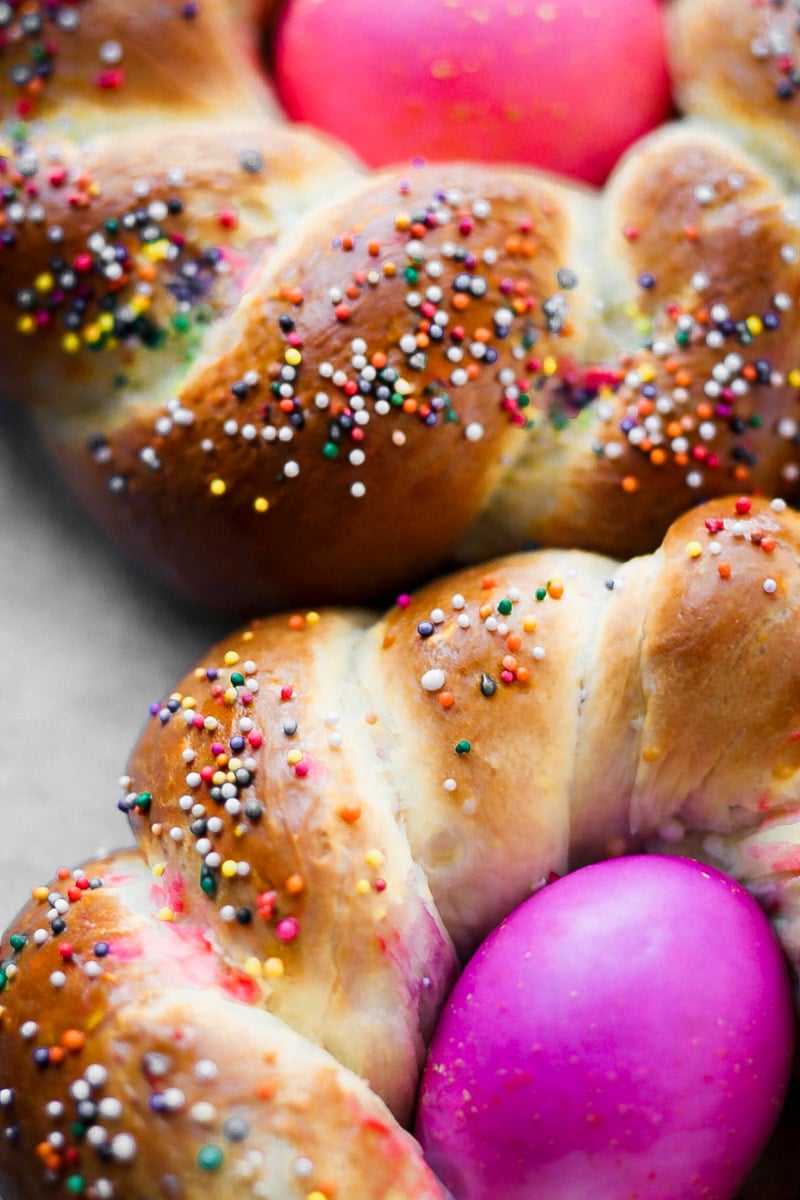
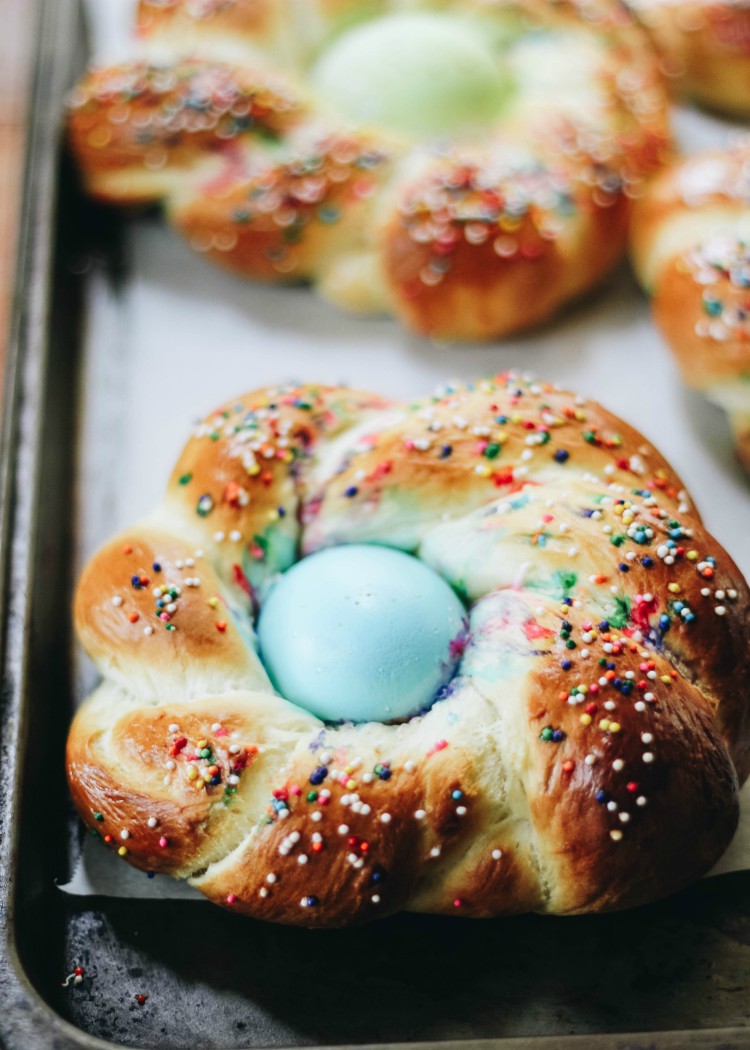
Pane di Pasqua, or Italian Easter bread, is a soft, slightly sweet braided bread traditionally made in Italy to celebrate Easter. You'll often see it shaped into wreaths or braids with colorful eggs baked right into the dough, which symbolize new life and the arrival of spring.
In my experience, this bread is as much about tradition as it is about flavor. Growing up around Italian kitchens, Easter always meant the smell of sweet dough rising on the counter and loaves of this beautiful bread coming out of the oven, ready to share with family after Sunday mass.
This is a family favorite recipe I've been making for years. It's a recipe my mother-in-law makes for us when she is here visiting from Italy for Easter.
She is not too much into the colored eggs or even the sprinkles, but she does know how to make some really cool designs and shapes. She cranks out this Easter egg bread and I am finally starting to catch up with her speed - well, just a little.
Ingredients for Italian Easter Bread
Don't let the pretty appearance of this braided Easter bread fool you into thinking it has a lengthy ingredients list! Here's everything that goes into this Italian Easter bread recipe:
- Milk
- Active dry yeast
- Eggs
- Vanilla extract
- Granulated sugar
- All-purpose flour
- Lemon zest
- Kosher salt
- Unsalted butter
- Dyed eggs
How to Make Italian Easter Bread (Pane di Pasqua)
I've given detailed instructions on how to make Italian Easter bread in the recipe card below, but here are the basic steps for making this Easter sweet bread:
- Dye the Easter eggs.
- Mix together the yeast and warm milk. Set aside until foamy.
- Add the eggs and vanilla to the milk mixture.
- In a separate bowl, whisk together the flour, lemon zest, and salt.
- Using an electric mixture with a dough hook attachment, add the milk mixture to the flour mixture.
- Add the butter to the dough a little at a time.
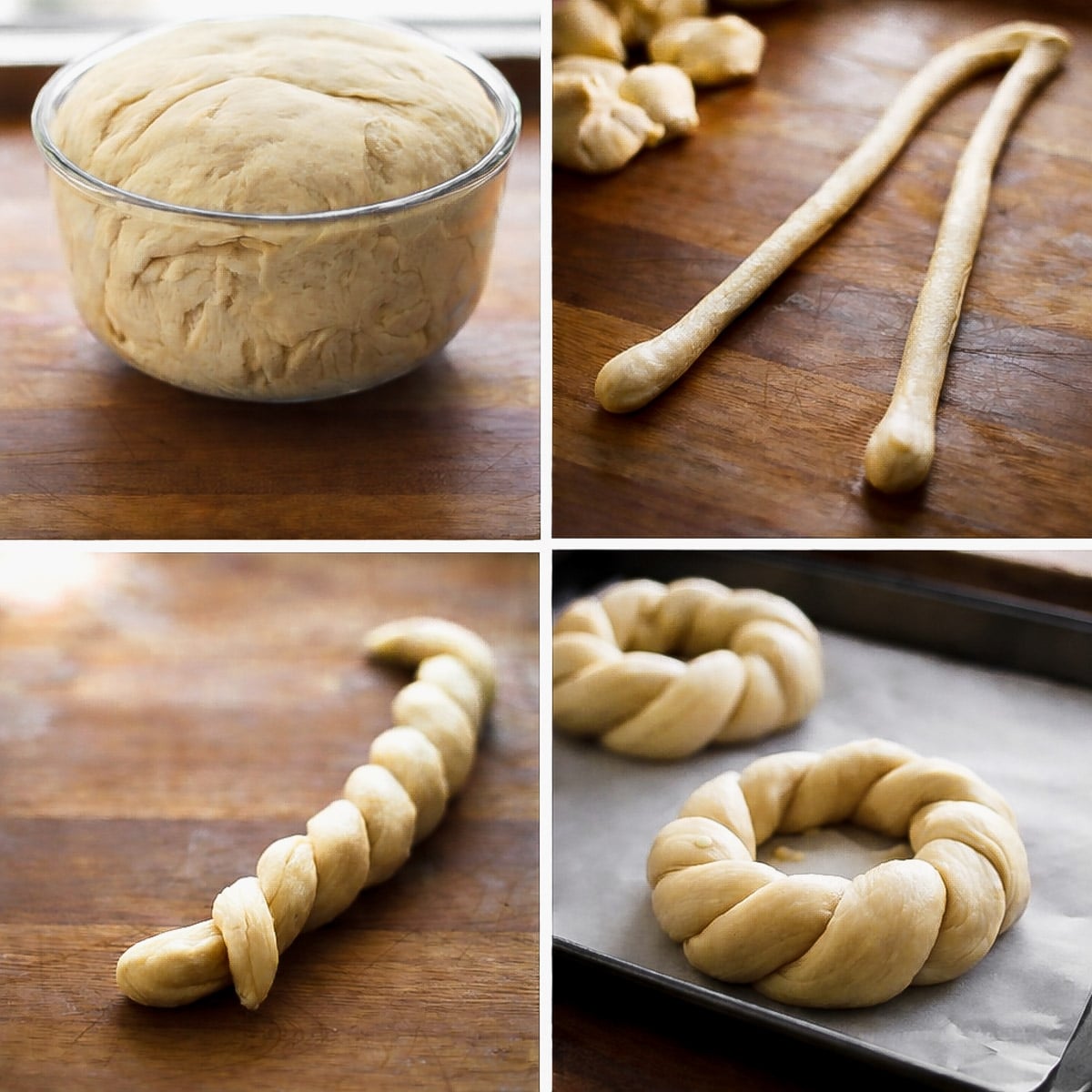
- Once the dough comes together, turn it onto a floured surface and shape into a ball. Place in an oiled bowl and let rise for an hour to 90 minutes.
- Once risen, gently punch down the dough and shape into the braided Easter bread (I've given specific instructions on how to shape the dough in the recipe card below).
- Brush the braided dough with egg wash, then let rise for a second time.
- Bake the Italian Easter bread until golden.
Should I Use Raw or Hard-Boiled Eggs?
I color the eggs while they are uncooked. When you nestle them into the dough and place in the oven to bake, they will be completely cooked when you take it out. If you do have hard-boiled eggs and decide to use them in the bread, the eggs will be very cooked after it bakes inside the bread. I think the texture of the eggs when you put them uncooked in the bread and bake them is the right texture.
Tips for Making Italian Easter Bread
- Shaping the ropes. When you make the ropes, make sure you don't make them too long, otherwise your little nests to hold the eggs will be too wide. The dough ropes do shrink as you roll them and then shrink again when you stop. I would measure them and make sure they're not over 12 inches long. If the ropes are too skinny, the nests will be too wide.
- Measuring the flour. I use between 4 ½ and 5 cups of flour, but never more than 5 cups. If you add more than 5 cups, the dough will be too dry. I do mention in the recipe to start with 4 ½ cups and add a tablespoon more of flour at a time until it is a pliable dough, not too sticky, and not dry.
- Sweetening the bread. For the sweetness, ½ cup of sugar is perfect for our taste. You could add another ¼ cup if you like your dough more sweet. You could also add a powdered sugar glaze on top after baking and add sprinkles on top (if you do the glaze, don't add sprinkles before baking). The sweetness depends on your taste.
Tips to store and make this Easter bread ahead of time:
This bread will stay fresh in large zipped lock bag or in an airtight container, for up to 5 days. Stores for up to 2 months in the freezer. Make sure it is wrapped tightly. Do not freeze the bread with the eggs.
FAQ'S
I always use raw eggs. When you nestle them into the dough and bake, they cook perfectly inside the bread. Hard-boiled eggs will work too, but they'll be very firm after baking - so I prefer starting with raw ones for the best texture.
Yes! You can make the dough a full day ahead and refrigerate it overnight. When you're ready to bake, let it come back to room temperature, then shape and proceed with the second rise as usual.
Absolutely. Shape the braided nests and freeze them before baking, or freeze after baking without the eggs. Wrap each one tightly in plastic wrap and store in a freezer bag. When ready, thaw, let them complete their final rise, and bake as directed.
In Italy, Pane di Pasqua is rich with meaning. The braided dough traditionally represents the Holy Trinity, and the eggs symbolize rebirth and the resurrection of Christ. It's as much a spiritual tradition as it is a delicious one.
The Italian Easter Bread My Mother-in-Law Makes Every Year
We were so lucky to have my in-laws spend a few Easters here with us. Since we couldn't go to Italy this year, it was just as good to have a little taste of Italy here as soon as they arrived at the airport. My mother-in-law is just the best!
She barely brings any clothes (a totally no-fuss, low-maintenance kind of a lady) and instead brings a suitcase FILLED with goodies for all of us. And I mean, GOODIES!
When I say goodies, I mean just food things. Like pasta and different chocolates. She brings us various canned goods that she makes.
Oh, and a ton of hot peppers that she grows! She makes a sauce with them and also brings them whole and dried. There are still some left from their visit to us last April.
Since my in-laws couldn't make it to visit this year for Easter, I had to get started a little early on the baking!
The kids were wondering when we would color eggs and when they could shape their own rolls. This Italian Easter bread is so wonderful that my mother-in-law even makes it in the summer when we are there (minus the Easter eggs). It's the perfect sweet bread to enjoy with a hot cappuccino!
More Easter Recipes:
- Sicilian Ricotta Pie
- Lemon Ricotta Cake
- Fresh Strawberry Bundt Cake
- Pastiera Napoletana (Neapolitan Easter Pie)
- Tsoureki (Greek Easter Bread)
- Lemon Bundt Cake with Lemon Curd Filling
Did you make this and love it? Please RATE THE RECIPE below:)
I would LOVE IT if you can leave me a star rating and a review down below and let me know your thoughts! It means the world to me to hear how you liked it.
Please Subscribe and give a follow on Instagram, Facebook, Pinterest, and TikTok xx

Italian Easter Bread (Pane di Pasqua)
Ingredients
- 1 cup milk
- 1 packet active dry yeast (¼ ounce envelope)
- 4 eggs , room temperature
- 1 teaspoon vanilla extract
- ½ cup granulated sugar
- 4 ½ cups unbleached all-purpose flour (may need more as mixing)
- 1 Tbsp. lemon zest
- 1 teaspoon kosher salt
- 8 Tbsp. butter , melted and cooled
- 7 dyed eggs (follow instructions on the food coloring)
Egg Wash:
- 1 egg
- 1 Tablespoon water
Instructions
- If you are adding colored eggs, now is the time to color them. Follow the dye directions on the box or use natural dye and let the eggs sit for an hour. The longer they sit the more vibrant the color.
- In a small saucepan heat the milk over medium to 110 F (I just test the water with my finger and know it's the right temperature…warm like the temperature of a baby bottle, not hot). Add the yeast to a small bowl with the warm milk and whisk it around with 1 tablespoon of the sugar. Let sit until foamy (about 5 minutes).
- Whisk in the eggs and vanilla and set aside.
- Pour the flour mixture in the bowl of a mixer. With dough hook attached and mixer on medium speed, slowly add the milk mixture (*the milk mixture has the milk, yeast, 1 tablespoon sugar, eggs, vanilla) to the flour mixture.
- Hold onto your mixer! Now you will add the butter 1 tablespoon at a time. I tell you to hold onto it because it will move around if you are mixing it on too fast of a speed. Start on medium-low speed. If you notice the mixer moving too much, you can lower the speed and let the butter get gently incorporated into the dough. If you have the mixture at a faster speed at this point…do not leave it alone while it's mixing. It could bounce off the counter.
- Be sure to mix well when all the butter is added (about 3-5 minutes). You may need to add more flour. (Start with 4 ½ cups of flour. If you need more flour, add more a Tablespoon at a time until it is no longer sticky. Don't worry about the total amount of flour, keep adding until your dough is stiff and elastic, and it is not sticky.)
- Put a little flour onto a clean counter and scrape the dough out of mixer onto the counter. Knead the dough a little and shape the dough into a ball (you won't be kneading the dough too much…just a bit to shape it into an elastic ball of dough).
- Oil a large mixing bowl and place the dough into the bowl.
- Rub a little oil on top of the dough and cover it to rest in a draft-free area for a bout 1-1 ½ hours.
- Punch down the dough.
- Divide the dough into 14 portions. Roll each portion into a strip about 12 inches long. You could also make one large braid with this dough. If you are making one large braid, roll each piece into strips about 15 " long. If you are making two braids, the strips will be a bit smaller (sorry, I did not measure the strips)
- Start with two pieces: pinch the ends together of the first 2 ropes to secure the strips together Bring one side over to the other and tuck it in to make a small ring shape. You're making a little nest for your colored egg to nestle into. Make sure your ring is not too big and not too tight.
- Preheat oven to 350 F.
- Repeat process with the next 6 sets of 2 ropes that you will make. You will have 7 little nests to hold your eggs.
- Place on two baking sheets lined with parchment paper (or a silpat mat).
- In a small bowl, whisk together the egg and water for the egg wash. Brush on the egg wash.
- Cover the dough with a kitchen towel to proof for about 40-45 minutes.
- When dough is ready to bake, brush on some more egg wash. Sprinkle on the sprinkles. Place an egg in the middle of each little nest.
- Bake for about 18-20 minutes. If you are making one very large wreath, it should be done in 25-30 minutes.
- Don't forget to eat the yummy eggs that are baked in the middle of the bread. My kids fight over them! In order for the raw eggs to cook, they will need 18-20 minutes in the oven. If you prefer to add eggs already cooked, hard boil them and color them (according to color instructions)and add them already cooked to the bread. *If you have left bread out with eggs for a couple hours, just discard the eggs, and eat the bread.
Nutrition Disclaimer
Please keep in mind that the nutritional information presented below is an approximation and may vary depending on the exact ingredients used.
Notes
Eggs, milk, and butter blend into the dough more evenly when they aren't cold, which helps the bread rise better and stay soft. Let the dough rise fully.
Don’t rush the proofing time. I always let the dough double in size so the bread bakes up light and fluffy instead of dense. Braid the dough loosely.
Leave a little space when shaping the braid. The dough expands during the second rise and in the oven. Brush with egg wash.
A simple egg wash before baking gives the bread that beautiful golden color and slight shine. Let it cool before slicing.
Nutrition
THIS POST CONTAINS AFFILIATE SALES LINKS
Happy Easter Lora!! I made your Italian Easter bread today, and it came out amazing!!! Not only were they beautiful but so light and fluffy and flavorful! My family was so impressed. This is an amazing recipe and I will definitely be making these throughout the year just like your grandma. I wish I could post a picture because I’m so excited about how beautiful they came out. Thank you for sharing your Grandma's recipe!!
Hi Kathy-So very nice of you to write me. Thank you for letting me know it turned out to be a success and that you'll make it throughout the year. ENJOY! Happy Easter to you and your family!
Better than my mother-in-law's. my husband can't tell the difference whether it's mine or hers. Thank you so much for the recipe she would not give it to me so I looked it up and found yours! And it's perfect
Hi Rita-WOW...now that is a compliment, for sure! I'm really happy you enjoyed my Easter bread. Buona Pasqua!!
Hi, I know this is going to be wonderful because so similar to a recipe I lost. I wrote you asking about the amount it makes...you mentioned 14, but I'm not sure if that is correct. I know there are 14 pieces, but I thought there were only 7 nests. I am also wondering, if I free the unbaked dough, am I only letting it rise for 90 minutes and then shaping and freezing? Or do I need to let it rise again before freezing the dough? Sorry. Wasn't clear on that.
Hi Michele: You’re right: it makes 7 nests total. The 14 pieces refer to the dough strands, since each nest is made with 2 ropes.
For freezing, here’s what I recommend:
Let the dough go through the first rise (about 1–1½ hours), then punch it down, shape the nests, and freeze them. When you’re ready to bake, let them thaw and rise again until puffy before adding the egg wash and baking.It took me a minute to understand, as you wrote "if I free the unbaked dough", but I now realize you meant to write: Freeze. ENJOY! Happy Easter!
Can I make 2 long braided breads instead of the nests and how long would they have to bake
Hi Sara-If making 2 long braids, let the dough rise 1 to 1½ hours until doubled. After shaping the braids, let them rise again 40–50 minutes.
Bake at 350°F for 25–30 minutes, or until golden brown. If the top browns too quickly, loosely cover with foil.Enjoy!
If I only make one large long braided bread instead of the small round bread how long would I bake it for. Love your recipes. I also make the lita ‘ pigliate with your recipe. Thank you
Hi Sara-THANK YOU! Here is the original Easter bread I posted as one long braid. Check it out (and I realize time to update that post a bit). But it has the timing and instructions in there: https://www.savoringitaly.com/italian-easter-bread-guti-di-pasqua/
ENJOY!
Very good recipe! Thank you for sharing! My only addition is I add golden raisins
I've been baking this with my kids for years. A really great recipe! The eggs are so fun and messy to make!!
Hi Jessie-Thank you for taking the time to let me know you love our Easter bread. Yes, the eggs are fun and very messy!!
Ciao Lora-Gabriella! Our Nonnna made these for us every year when we were kids. She always shaped them as Easter bunny’s and decorated them with jelly beans. Each grandchild got one. The only difference was she made them “Calabrese” style by adding Anise seeds. Buona Pasqua!
Ciao Ken-How wonderful that you nonna made them shaped as bunny's and decorated with jelly beans. What great memories! Buona Pasqua!!
Excellent recipe. I made them today for Easter tomorrow. My husband and son love them. Thank you so much for sharing your recipe. ❤️ it’s a keeper!
Hi Debbie-SO happy you made the bread and that your family enjoyed it! Happy Easter!! XX
Excellent recipe
Thanks
Hello -THANK YOU so much 🙂 So happy you enjoyed!!!
Great recipe! I used orange zest instead of lemon zest and also added a tsp of cardamom (older cardamom... probably wouldn't have used that much super fresh cardamom!)
Also! I accidentally melted the butter in with the milk because I didn't read ahead far enough and it still turned out completely perfectly so that might be an easier way of doing it.
And I blew my eggs first and had the insides scrambled for breakfast. It worked great.
Hi Olivia-Thanks for taking the time to leave a comment:).Really happy you enjoyed the bread and subbed in orange for the lemon zest, and that you added in cardamom (YUM)! I've melted the butter in the pan with the milk...but usually do it separately:) either way, it does always turn out.Happy Baking! XX
This was beautiful! Don't tell my mom, but I liked it better than Nonna's!
Hi Rochelle-That's so kind of you to take the time to leave a comment. And thank you for letting me know you really enjoyed the bread (I won't tell your mom;) XX
Send recipes
Hi Donna-Ok, I'll add you to the list! Thank you:)
Hello,
I would love to make this bread. Can you tell me how do you store the baked bread? And can you freeze it?
Hi Mirta-If you look at the end of the post, there are some notes on how to store + freeze. Happy baking! XX
Mine came out beautiful . Thank you for the easy recipe! Didn't change a thing!
Hello! I just made these and they smell amazing! Have you ever tried freezing them?
Hi Melina-Yes, go ahead and freeze them (without the eggs). Defrost overnight on the counter and you could heat up on a low heat for a few minutes (like 5 mins on 325F).
ENJOY!
Hi , question when you bake the bread and it comes out of oven does the egg colors fade or get spotty ? I don’t make this but we always made cookies with the egg. My colors look great going in the oven but not when they come out . So how are you getting yours to be so vibrant,
Hi Virginia-if you look carefully at the first 3 photos, you'll see some spots and fading. The last photo with the eggs is with the bread before baking, and that's the photo where the colors is not spotty or has faded spots. I do leave my eggs in the color typically for a while to get more vibrant colors and sometimes I buy those "neon colors", so maybe that could be why they seem more vibrant. Hope that helps!