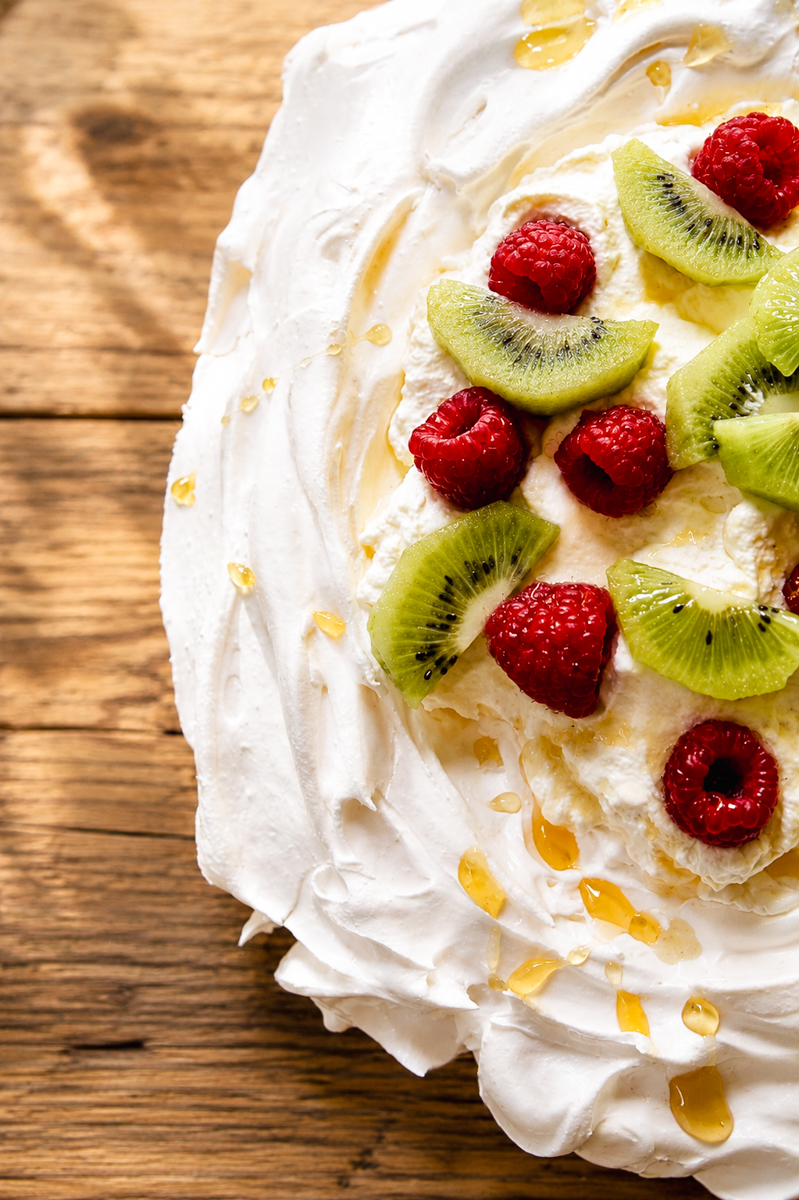
This easy pavlova recipe makes a showstopper dessert with a crisp meringue shell, a soft marshmallow center, and a topping of whipped cream, fresh kiwi, raspberries, and honey. Naturally gluten-free and not as difficult as it looks.
You might also like: Lemon Ricotta Cake or No-Bake Strawberry and Mascarpone Dessert
This article contains affiliate links which support us at no extra cost to you.
Jump To
Pavlova is one of those desserts that looks incredibly impressive and is actually very manageable once you know a few key rules. Crispy and golden on the outside. Soft and marshmallow-like in the center. Piled high with whipped cream and fresh fruit. It is a guaranteed crowd-pleaser every single time.
I make this when I really want to wow people. The results always deliver. The meringue does most of the work while it sits in a low oven, and the topping comes together in minutes. Kiwi and raspberries are my favorite combination: the tartness of both fruits cuts through the sweetness of the meringue beautifully. A drizzle of honey over everything at the end takes it to another level.
A few simple techniques make the difference between a pavlova that holds together and one that collapses. I will walk you through all of them.
Why You'll Love This Recipe
- Naturally gluten-free with no substitutions needed.
- Impressive presentation for very little hands-on work.
- The meringue can be baked the day before and topped just before serving.
- Completely customizable with whatever fruit you have.
- Crispy outside, marshmallow inside - the best texture contrast in dessert.
Ingredient Notes
Meringue
- Egg whites: 4 large egg whites, at room temperature. Cold egg whites do not whip as well. Let them sit out for 30 minutes before you start.
- Sugar: Regular white granulated sugar. Add it slowly, one tablespoon at a time. This is what builds the glossy, stable peaks.
- Cornstarch: The secret to the marshmallow center. It stabilizes the meringue and keeps the inside soft even after baking.
- Salt: Just a pinch. It helps the egg whites whip up faster and balances the sweetness.
- White wine vinegar: Another stabilizer. It reacts with the egg whites to give the meringue structure and contribute to the chewy interior. You will not taste it in the finished pavlova.
- Vanilla extract: Split between the meringue and the whipped cream topping. Use real vanilla.
Topping
- Heavy cream: Must be chilled. Warm cream will not whip. Keep it in the fridge until the moment you need it.
- Plain yogurt: Half a cup of chilled plain yogurt folded into the whipped cream adds a subtle tang that balances the sweet meringue. Greek yogurt works well here too.
- Raspberries: Fresh raspberries only. Their tartness is perfect against the sweet cream and meringue.
- Kiwi: Peel and slice just before serving. Kiwi contains an enzyme that can break down the whipped cream if it sits for too long.Honey: A light drizzle over the finished pavlova. Adds floral sweetness and a beautiful gloss.
How to Make This Easy Pavlova
Step 1: Prepare Your Pan
Preheat oven to 200°F. Line a baking sheet with parchment paper. Use a 9-inch plate or bowl to trace a circle on the parchment as a guide, then flip the parchment over so the pencil mark faces down but is still visible through the paper.
Step 2: Whip the Egg Whites
Let egg whites stand at room temperature for 30 minutes. In a small bowl, stir together the sugar, cornstarch, and salt and set aside.
In a stand mixer fitted with the whisk attachment, beat egg whites on medium speed until soft peaks form. The whites should look foamy and opaque but still droop when the whisk is lifted.
Step 3: Add the Sugar
With the mixer running on high, add the sugar mixture one tablespoon at a time. Do not rush this. Take about 5 minutes to add it all. The meringue will transform into a thick, glossy, brilliant white mixture that holds stiff peaks. Beat in the vinegar and half a teaspoon of the vanilla.
When the egg whites have quadrupled in volume and the peaks are stiff and glossy, stop. Do not overbeat. Get it onto the pan immediately.
Step 4: Shape and Bake
Spoon the meringue onto the parchment within your traced circle. Use a rubber spatula to shape it into a 9-inch disk. Build the edges up slightly higher than the center to create a shallow well for the toppings.
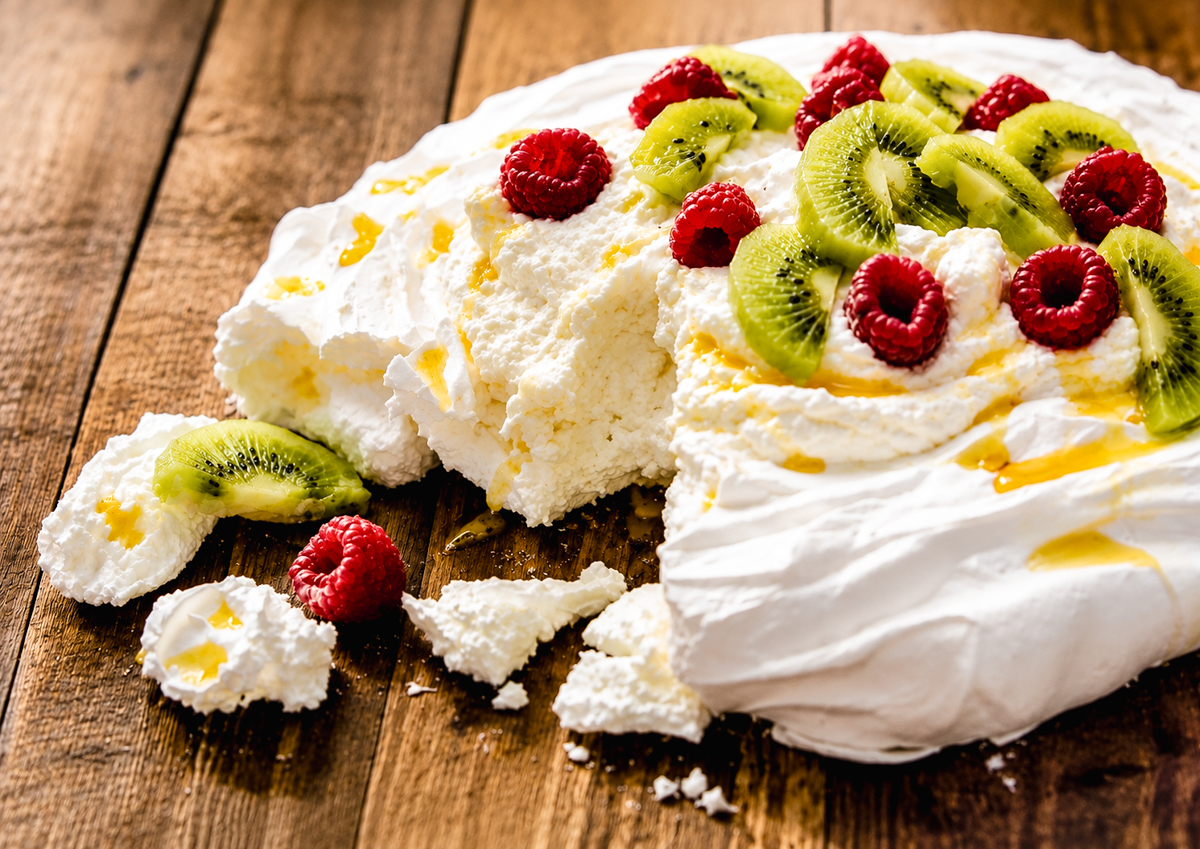
Bake for 1 hour. Do not open the oven door during baking. After 1 hour, turn the oven off and leave the meringue inside with the door closed for another 30 minutes. Then remove from the oven and let it cool completely on the pan, at least 3 to 4 hours. Do not rush this step. A warm pavlova will crack when moved.
Step 5: Top and Serve
Once completely cool, gently peel the parchment paper away and transfer the meringue to a serving plate using two metal spatulas. It is fragile. Take your time.
In a medium bowl, beat the chilled heavy cream, yogurt, and remaining vanilla until stiff peaks form. Spread the cream over the top of the meringue. Arrange the kiwi slices and raspberries over the cream. Drizzle with honey and serve immediately.
Tips for a Perfect Pavlova
- Make sure your bowl and whisk are completely clean and dry. Any trace of fat will prevent the egg whites from whipping properly.
- Room temperature egg whites whip to a higher volume than cold ones. Do not skip the 30-minute rest.
- Add the sugar very slowly. Adding it too fast causes a grainy meringue that weeps liquid.
- Do not open the oven door while the pavlova bakes. Temperature fluctuations cause cracking.
- Cool completely before moving. This is the most common mistake. Even a slight warmth will cause it to break.
- Top with cream and fruit only right before serving. The cream will soften the meringue if it sits too long.
- A cracked or slightly collapsed pavlova still tastes incredible. Pile on extra fruit and nobody will notice.
Variations
Change the Fruit
This pavlova works with almost any fresh fruit. Try sliced strawberries and blueberries, mango and passion fruit, peaches and cherries, or roasted autumn pears and figs. Match the honey drizzle to the season: wildflower honey with berries, dark buckwheat honey with pears.
Chocolate Pavlova
Add 2 tablespoons of good-quality cocoa powder to the meringue along with the cornstarch. The result is a rich chocolate shell. Top with whipped cream and raspberries or shaved dark chocolate.
Lemon Cream Topping
Swap the plain yogurt for 2 tablespoons of lemon curd folded into the whipped cream. It adds a bright citrus tang that pairs beautifully with summer berries.
Make-Ahead and Storage
- The meringue shell can be baked up to 1 day ahead. Store at room temperature in a cool, dry place loosely covered. Do not refrigerate the bare meringue - humidity will soften it.
- Once topped with cream and fruit, the pavlova should be eaten within a few hours. The cream softens the meringue quickly.
- Leftovers can be stored in the fridge for up to 1 day but the meringue will no longer be crispy. It is still delicious, just softer throughout.
- Do not freeze.
What is the difference between a meringue and a pavlova?
A meringue is a mixture of whisked egg whites and sugar and a pavlova is a type of meringue. Pavlovas have a marshmallow-like center from the cornstarch.
Did you make this and love it? Please RATE THE RECIPE below:)
I would LOVE IT if you can leave me a star rating and a review down below and let me know your thoughts! It means the world to me to hear how you liked it.
Please Subscribe and give a follow on Instagram, Facebook, Pinterest, and TikTok xx
Easy Pavlova Recipe with Kiwi and Raspberries
Ingredients
Meringue
- 4 egg whites
- 1 cup sugar
- 2 teaspoons cornstarch
- ¼ teaspoon salt
- 1 teaspoon white wine vinegar
- 1 ½ teaspoons vanilla extract divided
Topping
- 1 cup heavy cream chilled
- ½ cup chilled plain yogurt
- 1 cup fresh raspberries
- 2 kiwi peeled and sliced
- honey
Instructions
Meringue
- Preheat oven to 200 F. Let egg whites stand at room temperature for 30 minutes.
- Using a rubber spatula, spread the meringue over the circle. Shape it into a 9" disk by making the meringue conform to the circular outline; smooth top and sides with rubber spatula.
- Bake for 1 hour and do not open the open door (make sure you don't open to just check on it...it will be fine).
- Turn off the oven and let the meringue dry in the oven with the door closed for 30 minutes. Remove from the oven and let it cool completely (about 3-4 hours).
- Gently peel parchment paper from the meringue and, using 2 metal spatulas, transfer meringue to a cake stand.
Topping
- In a medium bowl, beat the whipped cream, yogurt and 1 teaspoon of the vanilla until stiff peaks form. Pour the whipped cream mixture onto the cooled meringue and spread evenly over meringue's top using a rubber spatula.
- Decorate with kiwis and raspberries. Drizzle on the honey.
Nutrition Disclaimer
Please keep in mind that the nutritional information presented below is an approximation and may vary depending on the exact ingredients used.
Notes
- Room temperature egg whites whip to a much higher volume than cold ones. The 30-minute rest matters.
- Add sugar one tablespoon at a time. Rushing this step causes a weeping, grainy meringue.
- Do not open the oven during baking. Temperature changes cause cracking.
- The meringue shell can be baked 1 day ahead and stored at room temperature, uncovered. Add toppings just before serving.
- Cracking is normal. A pile of whipped cream and fruit covers everything beautifully.
Nutrition
FAQ: Easy Pavlova Recipe
All pavlovas are meringues, but not all meringues are pavlovas. A standard meringue is beaten egg whites and sugar, baked until fully dry and crisp throughout. A pavlova has cornstarch and vinegar added, which keeps the interior soft and marshmallow-like while the outside becomes crisp.
The outside should look dry, pale, and slightly matte when it is done. It will not be golden or brown. If you insert a skewer into the meringue, it should meet soft, sticky, almost marshmallow-like resistance in the center.
Some cracking is completely normal and almost expected. The most common cause of significant cracking is moving the pavlova before it has cooled completely, or a sudden change in oven temperature
Weeping (liquid pooling under the meringue) usually means the sugar was added too quickly and did not fully dissolve into the egg whites. To avoid it, add the sugar one tablespoon at a time and ensure it is fully incorporated before adding the next. High humidity can also cause stickiness - bake pavlova on a dry day if possible.
Yes. Bake the meringue shell the day before and store it at room temperature, loosely covered. Do not add the whipped cream and fruit until just before serving. The meringue can sit for up to 24 hours without any problem as long as it stays dry.
Yes. Almost any fresh fruit works. Berries, sliced stone fruit, tropical fruits like mango and passion fruit, citrus segments, or poached pears. Avoid very watery fruits that release too much liquid, as they can soften the cream quickly. Kiwi is best sliced and placed just before serving as it contains an enzyme that breaks down cream over time.