There are many recipes for pasta frolla and different ideas about how to make it. Simona gave us two versions that she has been using for some time. They have been inspired by those in the book La scienza in cucina e l'arte di mangiare bene by Pellegrino Artusi (1820-1911). The book was first published in 1891, and is available in English translation as Science in the Kitchen and the Art of Eating Well.
Version 1 of pasta frolla
Ingredients:
- ½ c. minus 1 tablespoon [105 ml, 100 g, 3 ½ oz] superfine sugar (see Note 1) or a scant ¾ cup [180ml, 90g, 3 oz] of powdered sugar
- 1 and ¾ cup [420 ml, 235 g, 8 ¼ oz.] unbleached all-purpose flour
- a pinch of salt
- 1 stick [8 tablespoons / 4 oz. / 115 g] cold unsalted butter, cut into small pieces
- grated zest of half a lemon (you could also use vanilla sugar as an option, see Note 2)
- 1 large egg and 1 large egg yolk, lightly beaten in a small bowl
- Nutella for filling: about 2 - 2 ½ cups (I didn't measure)
* I did not add the grated lemon zest or the vanilla sugar. I would probably add the lemon zest if I were making an apple crostata.
Note 1: Superfine sugar is often also referred to as ultrafine, baker's sugar or caster sugar. It's available in most supermarkets. If you cannot find "superfine" sugar, you can make your own by putting some regular granulated sugar in a food processor or blender and letting it run until the sugar is finely ground.
Note 2: There are different ways of making vanilla sugar. I keep vanilla beans in a jar half-filled with sugar until I need to use them, for example, to make vanilla ice cream. After I remove the split bean from the custard that will go into the ice cream maker, I rinse it, dry it and put it back in the jar with sugar.
I chose to make the pasta frolla by hand.
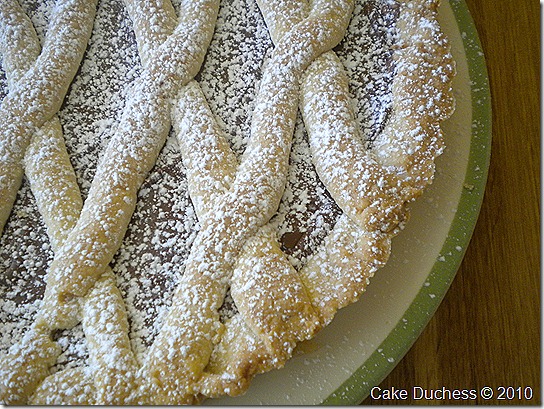
This is how my crostata looked when I first took it out of the oven. It was piping hot and the smell of Nutella was mesmerizing!

Look at how tempting this Nutella crostata is! Delicious!!
Of all the desserts I made this past week for Thanksgiving, this was by far…my FAVORITE!

Making pasta frolla by hand:
- Whisk together sugar, flour and salt in a bowl.
- Rub or cut the butter into the flour until the mixture has the consistency of coarse crumbs. You can do this in the bowl or on your work surface, using your fingertips or an implement of choice.
- Make a well in the center of the mounded flour and butter mixture and pour the beaten eggs into it (reserve about a teaspoon of the egg mixture for glazing purposes later on - place in the refrigerator, covered, until ready to use).
- Add the lemon zest to your flour/butter/egg mixture.
- Use a fork to incorporate the liquid into the solid ingredients, and then use your fingertips.
- Knead lightly just until the dough comes together into a ball.
- Shape the dough into a flat disk and wrap in plastic wrap. Place the dough in the refrigerator and chill for at least two hours. You can refrigerate the dough overnight.
Assembling and baking the crostata con la Nutella:
- Heat the oven to 325ºF.
- Take the pasta frolla out of the fridge, unwrap it and cut away ¼ of the dough. Reserve this dough to make the lattice top of the crostata. Refrigerate this dough while you work on the tart base.
- To help roll the crostata dough, keep the dough on top of the plastic wrap that you had it wrapped in. This can help rolling the dough and can also help when transferring the dough to your pan. You can also use parchment paper for this. However, you can also roll the dough directly on a work surface if you prefer.
- Lightly dust the top of the dough and your work surface (if you're rolling directly on a work surface) with flour. Keep some flour handy to dust the dough as you go along.
- If the dough is very firm, start by pressing the dough with the rolling pin from the middle to each end, moving the rolling pin by a pin's width each time; turn the dough 180 degrees and repeat; when it softens, start rolling.
- Roll the dough into a circle about ⅛th inch (3 mm) thick.
- If you used the plastic wrap or parchment paper as rolling surface, flip dough over the pan, centering it, and delicately press it all around so the corners are well covered. Peel away the plastic wrap.
- Trim the excess dough hanging over the edges of the pan. Press the remaining dough around the border into the sides of the pan making sure the border is an even thickness all the way around.
- Prick the bottom of the dough with a fork in several places.
- Take out of the fridge the reserved pasta frolla you had cut away earlier. Roll it with your pin and cut into strips or use cookie cutters to make small shapes (this is not traditional, but it looks cute); or roll with your hands into ropes.
- Instead of jam or fruit preserves, cover the bottom of the crostata crust evenly with the Nutella.
- Use the prepared strips or rolls of dough to make a lattice over the surface, or decorate with the cut shapes. (Note: You can use dough scraps to make cookies: see the Additional Information section for some pointers). I rolled out strips of the scraps and decorated the top of the crostata.
- Brush the border and strips of dough with the reserved beaten eggs. You can add a drop or two of water to the beaten eggs if you don't have enough liquid. (I did not brush the crostata with beaten eggs)
- Put the tart in the oven and bake for 30 minutes.
- After 35 minutes, check the tart, and continue baking until the tart is of a nice golden hue. (Note: Every oven is different. In my oven it took 45 minutes to bake the tart until golden.)
- When done, remove the tart from the oven and let cool. If you have used a tart pan with a removable bottom, then release the tart base from the fluted tart ring. Make sure the tart is completely cool before slicing and serving.
- Dust with powdered sugar.
Congrats on yet another Top 9 hun!! Your desserts always look incredibly good!!
Gorgeous! Nutella makes everything better. 🙂 Congrats on your first challenge! This was mine as well.
Hi love! What a beautiful job with this crostata...it looks like it should be sold at an Italian bakery...just perfect! I love hearing about recipes that have some family tie. I'm sure your mother-in-law would have been thrilled with this beauty! I love nutella, and I am always a fan of pastry dough/shortbread...so I hope to make this soon. Thank you for sharing, and again...job well done!
I take extra pasta frolla and make them into cookies. I love trying new pasta frolla recipes. And I am saving this for Christmas Eve. I figure even if I do blow the crust - no one will care when the filling is nutella.
Congratulations on your first challenge, great job!
Any excuse for a dessert with nutella in and I am there! Why didn't I think of doing that?!
Mmmm . . Nutella! Great idea for the crostata. Beautiful job.
Love this crostata! I would be all over this, I love Nutella!
Welcome to Daring Bakers! Your crostata looks great! I like the lattice work and the sprinkled powder sugar coating. Nice job on the challenge!
Great first challenge! This turned out beautifully. 🙂
what a beautiful crostata!! nutella is such a perfect choice for this time of year..you outdid yourself with DB challenge!!
The nutella calls me back to my time in Italy...sigh
Cheers
Dennis
Welcome to the Daring Bakers! What a gorgeous job you've done on your first challenge. The Nutella filling is such a great idea!
Lora-This is a superb and gorgeous nutella filled crostata. Not one morsel was left over. So amazing!
BEST filling choice EVER:)
I hope your crostata made your mother in law proud. Nutella was an excellent filling choice!
Gorgeous! What a beautiful tart and... who can go wrong with Nutella?!
Gorgeous! Congrats on completing for first challenge! I've been wanting to do one myself. This looks so good!
Congrats on your first challenge! This was my second. So much fun being part of this group. Your crostata is beautiful!
http://thejoyofcaking.wordpress.com
Amazing. I loove love love nutella! It is so beautiful topped with that powdered sugar. Yum!
What a wonderful filling 🙂 I'm glad you joined in on all fun! I've been doing it for a few months and I've loved every challenge so far! Cheers to not having to cook for turkey day! ha