If you are driving in Italy, you will almost certainly use an autostrada at some point. Italian toll roads are fast, well-maintained, and the quickest way to cover distance across the country. They are also pay-per-use, and if you have never used one before, the entrance and exit booths can be a little confusing the first time.
This guide covers exactly what you need to know: how to enter, how to pay, what things cost, and how to avoid tolls entirely if you prefer.
This article contains affiliate links which support us at no extra cost to you.
Jump To
If you are driving in Italy, you will almost certainly use an autostrada at some point. Italian toll roads are fast, well-maintained, and the quickest way to cover distance across the country. They are also pay-per-use, and if you have never used one before, the entrance and exit booths can be a little confusing the first time.
This guide covers exactly what you need to know: how to enter, how to pay, what things cost, and how to avoid tolls entirely if you prefer.
What Are Autostrade?
Autostrade (singular: autostrada) are Italy's toll motorways. They are the fastest roads in the country, typically with two lanes in each direction, and they are recognizable by their green road signs with white lettering. If a sign has a green background, you are on a toll road.
They are managed by private companies that charge tolls based on distance traveled. You collect a ticket when you enter and pay when you exit.
Main Italian Toll Roads
The most useful autostrade for visitors to know:
| Road | Route | Nickname |
|---|---|---|
| A1 | Milan to Rome to Naples | Autostrada del Sole |
| A4 | Turin to Venice / Trieste | Serenissima |
| A7 | Milan to Genoa | — |
| A8/A9 | Milan to Lake Como + the lakes | Autostrada dei Laghi |
| A10 | Genoa to Ventimiglia (Sanremo) | Autostrada dei Fiori |
| A11 | Florence to Pisa | — |
| A13 | Bologna to Padua | — |
| A14 | Bologna to Taranto | — |
| A22 | Brenner to Modena | Autostrada del Brennero |
| A1 south | Salerno to Reggio Calabria | Autostrada del Mediterraneo |
Italy's full network of autostrade runs from the French and Swiss borders in the north down to the tip of Calabria, with extensions into Sicily. Most have the format A + number and green signage.
How Italian Toll Roads Work
Entering the Motorway
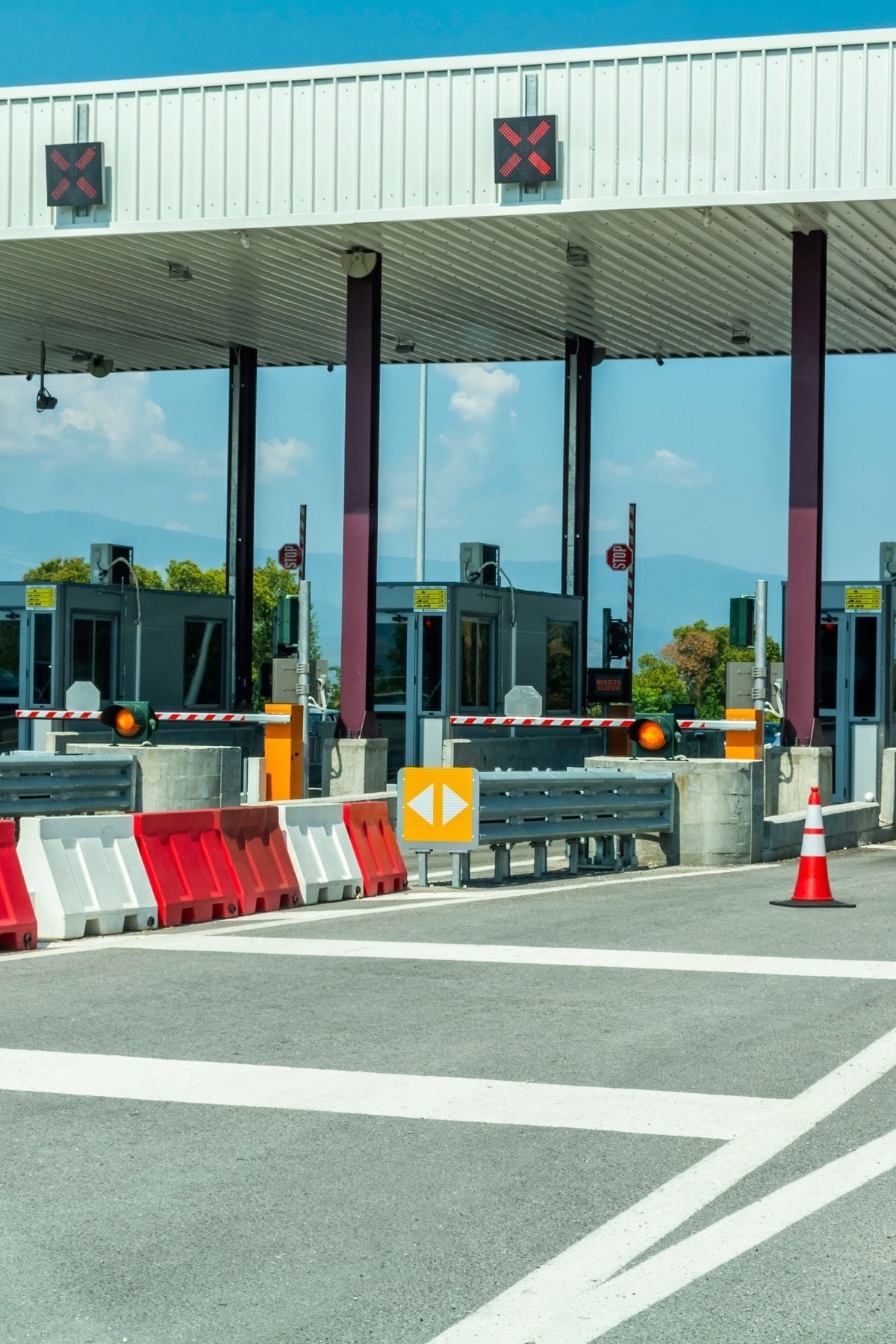
When you reach the entrance booth, choose the biglietto lane (not Telepass - that's for registered pass holders only). Stay in your car and pull up to the machine on your left. A ticket will be sticking out of the slot - take it and keep it somewhere safe. This ticket records where you entered and is used to calculate your toll when you exit. Lose it and you will be charged from the very start of the motorway, which can be expensive.
Exiting the Motorway
Highway exits are marked Uscita. When you see your exit announced, move right and follow the signs. At the exit booth, you pay your toll based on the distance covered.
How to Pay the Toll
At the exit booth, you will see lanes for different payment methods:
- Telepass - Only for cars with a Telepass device. If your rental car has one, the company will have told you. Otherwise, skip this lane.
- Card (Carte) - Drive up to the machine, insert your ticket when prompted (follow the green arrow), check the amount on the display, and pay by card. Make sure your card works in Italy before choosing this lane - there is no easy way to reverse if it does not.
- Cash (unmanned) - Feed your ticket into the machine, check the amount on the display, pay with coins or notes, and collect your change. Pull as close to the machine as possible on your left side - retrieving coins with a long reach is harder than it sounds.
- Cash (manned) - A real person at the booth. Hand over your ticket, wait for the amount to show on the display, and pay. The simplest option if you are not confident with the machine lanes.
Speed Limits and Road Signs
The maximum speed limit on Italian autostrade is 130 km/h in good weather and 110 km/h in rain. Speed cameras are common and fines are issued to foreign vehicles.
Multi-lane motorways sometimes have minimum speed limits per lane: 60 km/h in the right lane, 90 km/h in the middle. Blue signs with white numbers indicate a minimum; red-bordered white signs indicate a maximum.
Emergency pullouts are on the right side of the road. SOS columns (yellow) are placed regularly along the roadside - useful if you break down. Emergency: 112. Medical: 118.
Gas Stations and Food on the Motorway
Gas stations on Italian motorways are called area di servizio. They always have fuel and usually have a café with coffee, sandwiches, and hot food. Larger ones have sit-down restaurants.
The most common motorway food chain is Autogrill - reliable, consistent, and genuinely decent by road-stop standards. The breaded chicken sandwich (panino con la cotoletta) is an Italian road trip institution.
Important: Fuel pump color coding in Italy differs from the US. Always read the label before filling. Benzina is petrol, diesel is diesel.
How Much Do Italian Tolls Cost?
Tolls are priced by distance. A rough guide:
- Milan to Rome (about 536 km): approximately €41 to €45
- Naples to Salerno (82 km): approximately €5 to €6
- Florence to Bologna (about 100 km): approximately €7 to €9
- Turin to Venice (about 290 km): approximately €21 to €24
For an exact quote before your journey, use the official Autostrade toll calculator - enter your start and end points and vehicle type.
How to Avoid Italian Toll Roads
If you want to skip tolls entirely, Italy has a parallel network of Strade Statali (SS roads), marked by blue signs with white writing and the prefix SS. They are narrower and slower than autostrade but still good roads, and the speed limit is usually 90 km/h.
For shorter distances or scenic routes - like driving along the Ligurian coast or through Tuscany - the SS roads are often more interesting than the motorway anyway.
Set your GPS to "avoid tolls" to automatically route you on these roads. The journey will take longer but can save meaningful money on longer trips, and you will see far more of Italy along the way.
Key Italian Motorway Vocabulary
Autostrada - motorway/toll road Casello - toll booth Biglietto - ticket Pedaggio - toll Uscita - exit Area di servizio - service station/gas station Benzina - petrol Servito - manned service Telepass - electronic toll pass Piazzola di sosta - emergency pullout Casellante - toll booth operator
FAQ
Do I need cash for Italian toll roads? Not necessarily. Card payment is available at most exit booths. However, having some euro coins is useful in case a machine has issues or if you end up in a cash-only lane unexpectedly.
What is Telepass? Telepass is Italy's electronic toll system, similar to E-ZPass or a UK Dart charge tag. Subscribers have a device in their car that automatically deducts the toll as they drive through - no stopping required. Unless your rental car comes with one, you will not be using it.
What happens if I lose my ticket? You will be charged as if you joined the motorway at its very start, regardless of where you actually entered. This can be expensive on long motorways. Keep the ticket somewhere easy to find.
What is the speed limit on Italian motorways? 130 km/h in good conditions, reduced to 110 km/h in rain. Newly licensed drivers and vehicles towing trailers have lower limits.
Can I pay with a foreign credit card? Usually yes. Major international cards work at most toll booths. It is worth having a backup payment method just in case.