
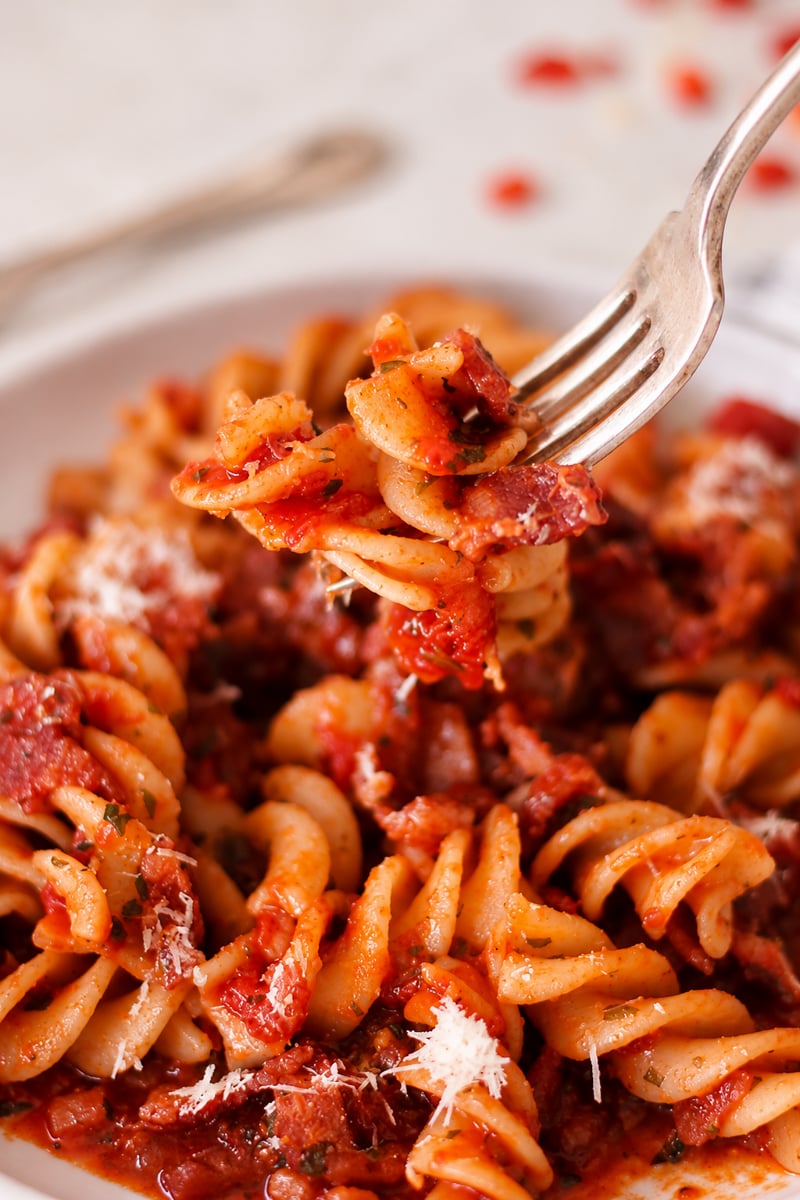
Pasta all'Amatriciana is a classic Roman pasta made with crispy guanciale, Italian tomatoes, a pinch of chili and plenty of Pecorino Romano. This version uses fusilloni, but bucatini, spaghetti or rigatoni all work, and the sauce comes together with a handful of pantry staples.
It's one of the four great Roman pastas, along with cacio e pepe and spaghetti alla carbonara.
This article contains affiliate links which support us at no extra cost to you.
Jump To
- Why You'll Love This Amatriciana Recipe
- What Does Amatriciana Mean?
- Authentic Amatrice Recipe vs. Roman Amatriciana
- Ingredients for Amatriciana Sauce
- Equipment you need to make this pasta
- How to make amatriciana sauce?
- Expert Tips
- Variations
- Storage
- Some other pasta recipes to enjoy:
- Easy Pasta All'Amatriciana (Fusilli Amatriciana)
- FAQs
Today we're taking another trip to Rome. This is the third of the four classic Roman pasta recipes I've shared here, and the fourth, pasta alla gricia, is the white version that Amatriciana grew out of. If you want all four in one place, here is my guide to traditional Roman pasta dishes.
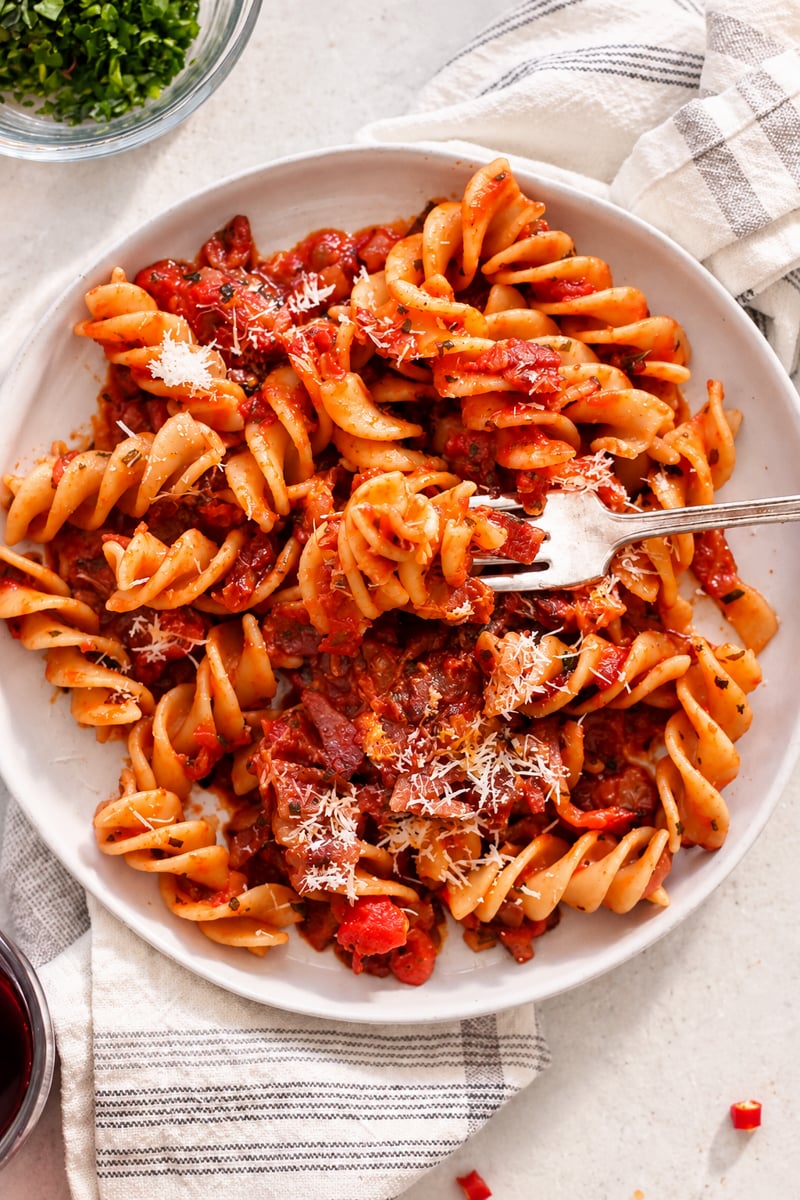
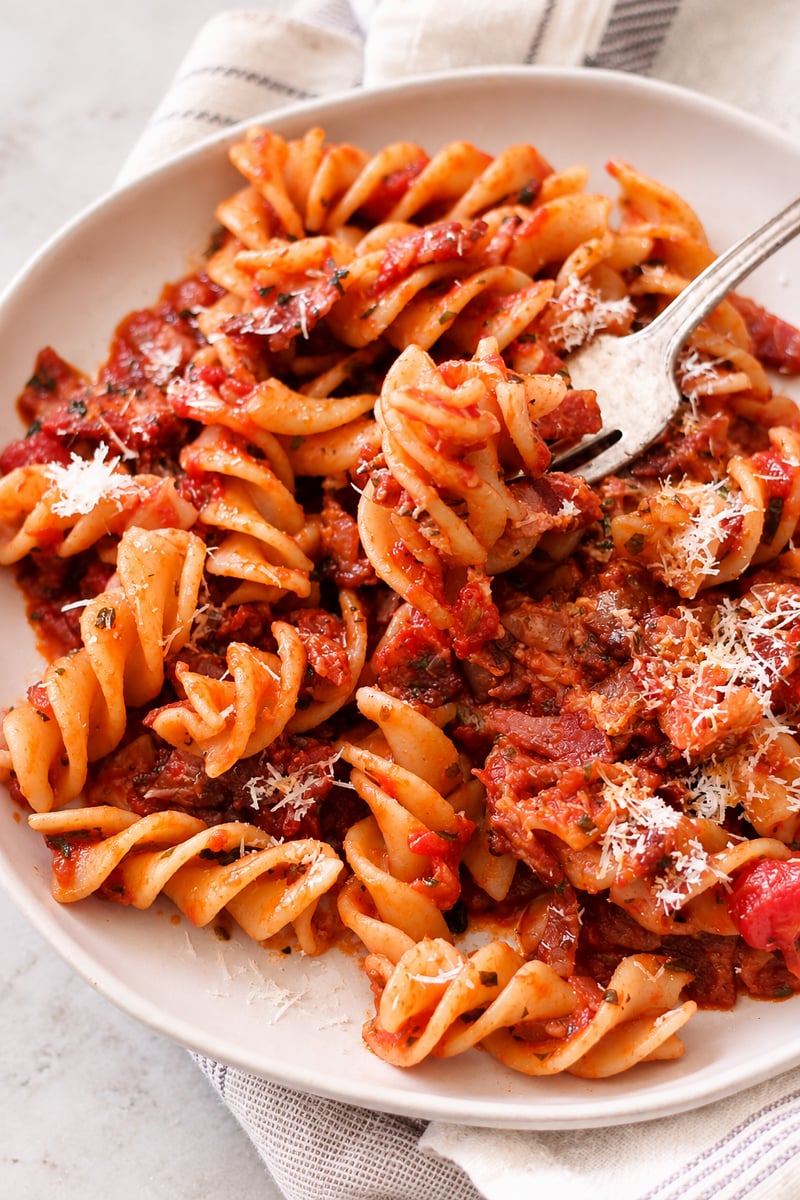
There's hardly a day that goes by that we don't make pasta for lunch or dinner (sometimes both!). It's easy, economical and so flavorful with simple ingredients. Amatriciana is traditionally made with bucatini or spaghetti, but I used fusilloni. The big curves and deep grooves hold onto the sauce, so every bite is full of tomato and guanciale. It's a recipe you'll love to make for guests.
Why You'll Love This Amatriciana Recipe
- Simple ingredients: guanciale, tomatoes, Pecorino, a little chili, and that's it.
- Big flavor: the rendered guanciale makes a rich, savory sauce without much work.
- Easy to adjust: make it spicy, skip the onion, or swap in pancetta.
What Does Amatriciana Mean?
Amatriciana means "in the style of Amatrice," a mountain town in the Lazio region northeast of Rome. In Rome you'll often see it called "matriciana," the Roman dialect form that drops the first A.
=How to pronounce it: ah-mah-tree-CHAH-nah. Say it together: Ama-Tree-Chee-Ana! The name is fun to say, and the pasta is one of the most delicious bites you'll ever take. Seriously!
Authentic Amatrice Recipe vs. Roman Amatriciana
This is where Italian purists start arguing. The town of Amatrice publishes its own official spaghetti all'Amatriciana recipe: spaghetti, guanciale, white wine, San Marzano tomatoes, Pecorino from Amatrice, chili, and a little olive oil. No onion and no garlic.
Roman versions often add onion, and sometimes garlic. Marcella Hazan used onion in her Essentials of Classic Italian Cooking, and I do too. I used a sweet onion; if I were in Italy I'd use a Tropea onion from Calabria. Use it or don't, it's up to you.
Ingredients for Amatriciana Sauce
For the pasta
- Pasta: 1 pound. Bucatini (spaghetti with a hole in the center) is traditional; spaghetti, rigatoni and mezze maniche are common too. I used fusilloni.
- Coarse sea salt: for the pasta water.
For the sauce
- Guanciale: 6 ounces. This is cured pork cheek (jowl), and it's the heart of the dish. It's not the same as bacon. Pancetta is the best substitute; use bacon only if that's all you can find.
- Extra-virgin olive oil: 3 tablespoons. Use a good one; you can use less if your guanciale is fatty.
- Onion: 1 medium, finely chopped (optional, for the Roman version). A sweet onion like Vidalia is great.
- Red chili: a pinch of red pepper flakes or a whole chili. Black pepper works if you don't like heat.
- Wine: ¼ cup. White is traditional in Amatrice; I used red. Pick one you'd drink, not cooking wine. It balances the rich guanciale.
- Tomatoes: one 28-ounce can whole peeled San Marzano DOP tomatoes, crushed by hand, or a jar of tomato passata.
- Fresh Italian parsley: ¼ cup chopped leaves (optional, not traditional).
- Sea salt: to taste. Go easy, since guanciale and Pecorino are both salty.
To finish
- Pecorino Romano: ½ cup grated, plus more to serve. Aged sheep's milk cheese that's saltier and earthier than Parmigiano-Reggiano. Need a swap? See my list of substitutes for Pecorino Romano.
- Starchy pasta water: about 1 cup reserved. The starch helps the sauce cling to the pasta and makes it silky.
Equipment you need to make this pasta
- A cutting board and a sharp knife for prepping vegetables
- A large pot for boiling pasta
- A large skillet for sautéing the ingredients
- A colander for draining the pasta
- Tongs or Pasta Spoon: To serve the pasta.
How to make amatriciana sauce?
Full printable recipe can be found below.

Forgot to include the oil in the group photo, so here it is below.

First step is to gather all the ingredients. Next, bring a pot of water to boil. Add salt when it comes to a boil.

In a large saute' pan, add the olive oil. When it is shimmering, add the guanciale and the onions. Cook until the guanciale gets crispy (about 10-15 minutes).

As soon as the guanciale is crispy, add the wine and deglaze the pan. Let it simmer together for a few minutes.

Next, add in the tomatoes. If I'm adding whole plum tomatoes, I like to break them up and remove the hard stem before I add them to the pan.
If using chili pepper, go ahead and add a little. Add the parsley and a little salt. Not too much salt. Start with a little bit, as the guanciale is salty. Let the sauce cook and simmer for 20-25 minutes. If it's too thick, ladle in a little bit of the pasta water.

Cook the pasta when you have about 10 minutes left for the sauce to simmer. Drain the pasta a couple minutes before it is al dente (reserve a cup of pasta water)and add it immediately to the pan with the sauce.
Stir it to combine on medium heat. Let the sauce coat the pasta. Let it simmer together for a minute (you want it to be al dente, not mushy), and plate up the pasta.

Serve with some Pecorino Romano cheese.
Expert Tips
- Guanciale is essential. If you use pancetta, it's "amatriciana con pancetta," and still delicious.
- Render slowly. Medium heat lets the fat melt out so the guanciale gets crisp, not burnt.
- Salt last. Taste the sauce after the guanciale and before the Pecorino; you may not need much.
- Finish in the pan. Tossing the pasta in the sauce with pasta water is what makes it glossy instead of watery.
- Choose your shape. Bucatini is classic; short pastas with ridges, like rigatoni, mezze maniche or fusilloni, catch the most sauce.
Variations
- Amatrice style: no onion or garlic, canned tomatoes rather than passata, and white wine to deglaze.
- Roman style: onion and sometimes a garlic clove cooked with the guanciale.
- Spicy: add more chili flakes or a whole fresh chili.
- Bianca: skip the tomatoes and you're making pasta alla gricia.
Storage
- Fridge: store leftovers in an airtight container for up to 3 days [confirm].
- Make ahead: the sauce keeps 2 to 3 days in the fridge; reheat gently and cook fresh pasta.
- Freezer: freeze the sauce alone for 2 to 3 months. I don't recommend freezing it mixed with pasta.
Some other pasta recipes to enjoy:
- Sicilian Pasta with Cauliflower
- Pasta alla Norma
- Orecchiette Pasta with Broccoli Sauce
- Ziti al Forno
Did you make this and love it? Please RATE THE RECIPE below:)
I would LOVE IT if you can leave me a star rating and a review down below and let me know your thoughts! It means the world to me to hear how you liked it.
Please Subscribe and give a follow on Instagram, Facebook, Pinterest, and TikTok xx
Originally published February 2023 and updated for content February 2024.

Easy Pasta All'Amatriciana (Fusilli Amatriciana)
Ingredients
- 1 lb fusilloni or bucatini, spaghetti or rigatoni
- Coarse sea salt for the pasta water
- 3 tablespoons extra-virgin olive oil
- 6 ounces guanciale cut into ¾- by ¼-inch strips (see notes)
- 1 medium onion finely chopped (optional; sweet onion or Vidalia)
- Pinch red pepper flakes or 1 whole chili
- ¼ cup red or white wine one you'd drink
- 1 28-ounce can whole peeled San Marzano tomatoes, crushed by hand, or 1 jar tomato passata
- ¼ cup chopped fresh Italian parsley leaves optional
- Sea salt to taste
- ½ cup grated Pecorino Romano plus more to serve
Instructions
- Boil water: Bring a large pot of salted water to boil for the pasta.
- Prep the guanciale: Use a sharp knife to trim the thick bottom skin of the guanciale (discard or reserve it to flavor a soup). Cut the guanciale into slices about ⅛ inch thick and then into ¾- by ¼-inch strips (or into cubes).
- Heat the olive oil: In a large saute' pan, add the olive oil. When it is shimmering, add the guanciale and the onions. Cook until the guanciale gets crispy (about 10-15 minutes).
- Add the wine: As soon as the guanciale is crispy and renders its fat, add the wine and deglaze the pan. Let it simmer together on a medium-high heat for a few minutes.
- Add in tomatoes: Next, add in the tomatoes. Use your hands to break up the tomatoes (I like to remove the hard stem). Use a wooden spoon to stir and keep breaking the tomatoes. You could also use tomato passata. Lower the heat and let it simmer gently, stirring occasionally, until the sauce is dense, 20 to 30 minutes.
- Cook the pasta: When the sauce has about 10 minutes of time to simmer, cook the pasta. Set your timer to 2 minutes before the cook time.
- Simmer the sauce: While the sauce is simmering, if it seems too thick, ladle in a little bit of the pasta water.
- Drain the pasta: Drain the pasta a couple minutes before it is al dente (reserve a ½ cup of pasta water)and add the pasta immediately to the pan with the sauce.
- Combine pasta and sauce: Turn the heat to medium-high and stir to combine with the sauce and coat the pasta. Add in a little bit of the pasta water to loosen the sauce if it's too thick. Let it simmer together for a minute (you want it to be al dente, not mushy), and plate up the pasta.
- Plate up the pasta: Serve with some Pecorino Romano cheese. Enjoy!
Nutrition Disclaimer
Please keep in mind that the nutritional information presented below is an approximation and may vary depending on the exact ingredients used.
Notes
- Guanciale- If you can find guanciale, do use it. Pancetta is a good substitute. Guanciale adds the rich, smoky flavor that is integral to the sauce.
- Starchy pasta water- Save some of the pasta water. A ladle could be added to the sauce while it's simmering if it's thickened too much.
- Sea salt - Use sea salt or kosher salt in the sauce. Not too much, as the guanciale is very salty. So taste the sauce before adding the salt, and adjust as needed.
- Pepper - Use hot chili pepper (whole or flaked) to your taste. You could also use freshly ground pepper, if you like.
- Make in advance - The sauce could be prepped ahead of time and stored in an airtight container in the fridge for 2-3 days.
- Storage - Any leftovers will stay fine in an airtight container for 2 days in the fridge.
Nutrition
FAQs
Yes, amatriciana sauce freezes very nicely. You could prep a big batch and separate the sauce in freezer safe containers (be sure to date the containers)and freeze for 2-3 months.
Yes, the sauce could be prepped in advance. Let it cool down completely and store in the fridge for 2-3 days. When ready to enjoy, cook up the pasta. Heat the sauce in a skillet and combine with the pasta. Sprinkle on some Pecorino and enjoy.
Bucatini or spaghetti are used. Mezze maniche rigate is another shape or you could use fussili or what we used, fusilloni.
If you can't get a hold of pecorino Romano, you could use you could substitute with Parmigiano Reggiano. Keep in mind the flavor will change.
This Easy Pasta all’Amatriciana is my new weeknight dinner! Yummy and easy to make.
Such a delicious classic dish! There is nothing more comforting than this pasta. Great leftover too!
This pasta dish was a hit with my family! It was easy to prepare, and so yummy, looking forward to making it again.
I made this for dinner and it was full of flavor. Simple ingredients but it tastes amazing!
This tasted like it came straight from a Roman bistro. The sauce is so rich and savory, but it’s actually really simple to pull together.
Wow! First of all, the dish is really good. Second, it introduced me to a new pork product. Yay!
Making your recipes has made me realize just how much American versions of sauce overcomplicate things. LOL
Pancetta was all I could find, so I used that. Wow. This is so, so good.
I remember one of my sons ordering this when we were in Rome! I had made it years ago, but it was fun for him to experience an authentic version. Next up will be YOUR recipe. xo
Hi Lizzy-How cool your son tried it in Rome :)) THANK YOU...I hope you do make it! XXX
REALLY LOVE this recipe. Made this for lunch and it's delicious! Thank you!