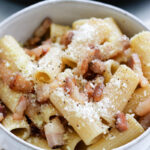
Pasta alla Gricia (With Guanciale)
Pasta alla Gricia is a classic pasta dish from Rome. It's made by combining guanciale (cured pork cheek), pecorino Romano cheese, black pepper, and starchy pasta water. Don't be fooled by the short list of ingredients, this pasta has rich and flavorful taste!
Servings: 4
Calories: 487kcal
Ingredients
- 9 oz. guanciale
- 1 Tablespoon extra-virgin olive oil
- 1 lb. dried rigatoni pasta
- 2 teaspoon freshly ground black pepper
- ¾ cup finely grated Pecorino Romano 2½ oz., divided
- Fine sea salt
Instructions
- Prep the guanciale: Place the guanciale on a cutting board and with a sharp knife, carefully slice off and discard the seasoned crust of the guanciale. Slice into ¼-inch-thick slices. Cut the slices into chunks about ½ x 1-inch pieces.
- Cook the guanciale: Heat a large saute’ pan to medium-low. Add in the guanciale and cook it. If your pan is not nonstick, add in some olive-oil. Stir it as it starts to cook up. Cook until it is crispy and a dark golden color (about 10-15 minutes). If you like the guanciale darker and crispier, cook it a few minutes more.
- Reserve the guanciale fat: Once the guanciale has cooked up, use a slotted spoon to remove the guanciale and add it to a small bowl. Reserve the guanciale fat in the pan.
- Boil pasta water: Meanwhile, fill a large pot with 3 quarts of water and bring to a boil. Once it boils, salt the pasta water with a tablespoon of sea salt (less salt is needed than typically used for pasta as the guanciale and cheese are salty).
- Cook the pasta: As soon as the water boils again after adding in the salt, add in the pasta and cook, stirring occasionally, until it’s just about al dente (check the time on your pasta box, as you’ll be cooking it about a bit more than half of the boxes’ recommended cooking time). Set a timer to remind yourself to check it. It will be a little chewy, as it will be a couple minutes before the al dente time, but it will finish cooking with the sauce.
- Heat the black pepper: When the pasta is few minutes before al dente, turn the sauté pan heat with the gaunciale fat to low heat. Add in the freshly ground black pepper. Give the pepper a swirl in the pan and as soon as it foams a little, it’s ready.
- Add pasta water: Carefully scoop out 1 cup of the starchy pasta cooking water and add it immediately to the pan and set aside another ½ cup of the pasta cooking water.
- Raise heat: Turn up the sauté pan heat to medium high and bring to a boil. Use a wooden spoon to stir the water with the fat and let it reduce a little.
- Drain the pasta: When the pasta is before al dente, drain the pasta in a colander and add immediately to the sauté pan.
- Finish cooking the pasta: Keep on cooking the pasta in the pan, stirring with a wooden spoon, and swirling it in the sauce. The sauce will emulsify and become glossy, and the pasta should finish cooking to a perfect al dente. Toss in the cooked up guanciale pieces and stir to combine.
- Remove pan from the heat: Stir in ¼ cup of the Pecorino and stir to combine until it is melted. Stir in another ¼ cup of the Pecorino and keep stirring, until it is melted and has a glossy consistency. If you add the cheese all at once, it may not melt correctly and break the silky emulsion, which will be clumpy. If the sauce is too thick, add in a little bit of the ½ cup of reserved starchy pasta water and stir to loosen it a little.
- Check the seasoning: Taste the pasta. The cheese and guanciale is salty, but if needed, add in a bit of sea salt, and stir to combine.
- Plate up pasta: Serve the pasta immediately. Optional: Sprinkle on the rest of the cheese and add on some more black pepper. Enjoy!
Notes
- Guanciale: Try to find a guanciale that has a simple salt + black pepper cure. There are other cures made with fennel or chile. If that’s the only guanciale you find, that is fine. Cutting guanciale can be tricky. The colder it is, the easier it is to slice. Freeze it for 10-15 minutes just before slicing makes it easier. If you can’t find guanciale, use pancetta or thick cut bacon in its place.
- Pasta: Every brand of pasta will have different cooking times. The goal is to cook the pasta to 2-3 minutes before al dente. The pasta gets transferred (either with tongs, or drained in a colander), right into the pan to emulsify with the sauce. It will finish cooking in the pan. Make sure you don’t overcook it.
- Cheese: Pecorino Romano is the ideal cheese for this pasta, and the traditional cheese. Be sure to grate the cheese on a microplane so it melts better. Do not use “Romano” cheese, as it’s not close in flavor to the authentic Pecorino Romano. Parmigiano Reggiano will work fine in its place. Please do not use Parmesan cheese, as the sauce will not be silky smooth and will not have the right flavor.
- Serve immediately: This is not a pasta to cook ahead of time. As soon as it is ready, serve up the pasta and enjoy it!
Nutrition
Serving: -16g | Calories: 487kcal | Protein: 7g | Fat: 51g | Saturated Fat: 19g | Polyunsaturated Fat: 0.4g | Monounsaturated Fat: 3g | Cholesterol: 68mg | Sodium: 547mg | Potassium: 0.04mg | Calcium: 0.04mg | Iron: 0.02mg